Contents
Africa’s Refining Pipleline
The history of African refining is chequered, to say the least. Of the many refinery developments that have been announced over the past decade, most stalled in their initial stages and few have made it to completion. Once built, problems have not let up, and refineries often struggle with consistently low utilisation as well as frequent outages. Further, the complexity of refineries has generally been low, limiting crude slate intake diversity as well as product output, leading to lower margins and lower product quality. Another element has been the difficulty in sourcing and guaranteeing a steady flow of local or regional crude, in part due to political and infrastructural obstacles. The Dangote refinery in Nigeria, despite facing many of the above issues, has turned into a relative success. Utilisation stood at an average rate of 83.6% in H1 2026, which is expected to increase further in the second half of the year after reaching full crude distillation capacity. Conversely, the Nigerian National Petroleum Company attempted restarts at the mothballed refineries Port Harcourt and Warri in late 2024, but after around 6 months the refineries shut down again.
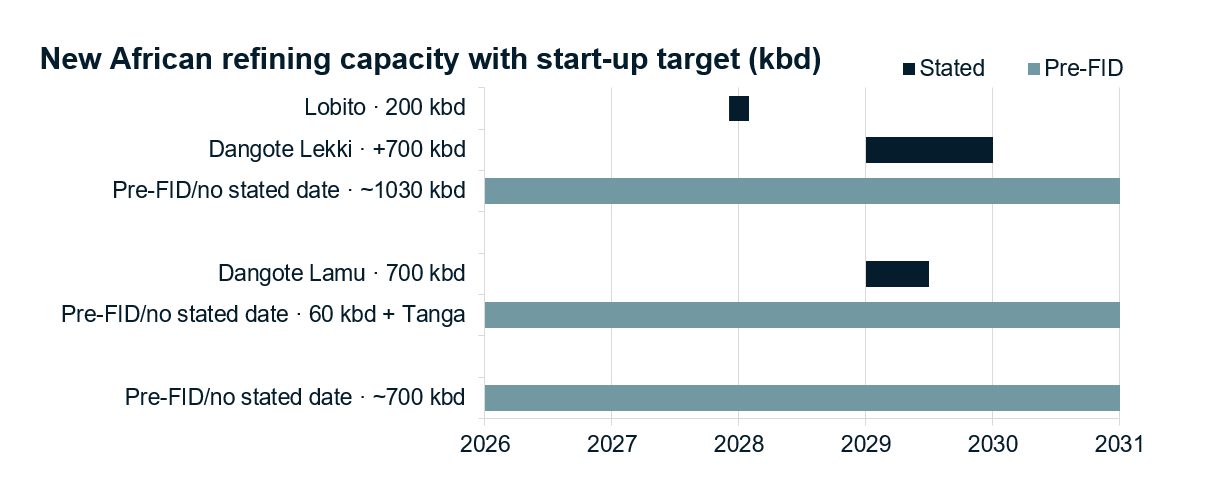
Current sky-high refining margins have given some impetus to the numerous ongoing refining projects across the continent, with national security interests a potentially equally strong driver. The Dangote refinery is already the largest refinery on the continent and looking to double refining capacity to 1.4mbd by 2029 bringing it in line with the world’s largest. Significant progress has been made towards financing, with a partial IPO imminent. However, given meaningful delays to the original build timeline, some doubts remain whether a 2029 completion date is possible to achieve. Dangote is also looking to build a copy of its Nigerian design in Kenya, the Dangote Lamu refinery, also with 700kbd of capacity, on an island off the east African coast. Groundbreaking is taking place at the end of September, but with no final investment decision (FID) taken and financing uncertain, this project could take many years to complete, if it does so at all.
Several other large projects are in their infancy, and most have had no FID taken, indicating uncertain prospects. An MOU was signed last month for the Tanga energy hub in Tanzania with a proposed refinery. No details have been released as to the projected capacity, or any kind of timeline. Similarly, in Côte d’Ivoire, Yaatra Ventures and SIR (the latter runs the country’s only refinery Abidjan), signed an MOU to build a 170kbd refinery in 2025, with little news since. The Lobito refinery, a 200kbd joint project between Sonangol and Sonaref, is under construction in Angola, initially guided for completing in H1 2027 this project looks likely to be delayed significantly, especially with further financing uncertain. Also in Angola, an expansion of Sonangol’s Luanda refinery was agreed between Sonangol and ENI in April 2025, from now 65 to 120kbd by 2028. Little news has reached the market since. In South Africa, a total of around 700kbd of new refining capacity is being discussed, including a 400kbd Sapref rebuild outlined this week. However, none of these discussions are post-FID. Further projects are in various stages of infancy.
Thus, the additional capacity expected to reach the market in the next couple of years is limited and is likely to come from expansions to already existing refineries. Any increases in East Africa especially are not expected for some years yet, maintaining reliance on imports from India and the Middle East and keeping the MR and LR2 markets here supported. In West Africa, the market is digesting high utilisation at Dangote, as product exports run at record highs, whilst imports are declining. Capacity here could start to expand from 2028 onwards, as expansions at Cabinda, Luanda, Dangote, and construction at Lobito near targeted start-up dates. If history is any indication, slippage is all but guaranteed. Nonetheless, the structural decline in product imports into especially West Africa looks set to continue, with projected demand growth covered by planned increases in refining capacity. Conversely, cross West African trade has flourished, but despite greater volumes the limited distances involved are likely to make this a net negative for clean tonne mile demand overall. If the Dangote refinery’s eventual success in procuring local crudes for the refinery lasts and can be replicated, the outlook for overall crude exports is also negative, though the impact could be mitigated by any increases in crude production.
New African refining capacity with start-up target (kbd)
Crude Oil
East
The AG/Red Sea VLCC market firmed significantly throughout the week, with a steady flow of enquiry gradually tightening the tonnage list and keeping owners firmly in the driving seat. Geopolitical tensions added further support to sentiment, while activity continued both on the surface and under the radar. As the week progressed, fixtures were concluded at increasingly higher levels, pushing freight to new highs. With cargoes still seeking coverage and little sign of the list easing, the market ends the week with strong momentum and no clear ceiling yet in sight.
The AG Suezmax market remained exceptionally firm as heightened regional risk combined with strong enquiry and a notably tight Suezmax list. Increased STS demand, Hormuz convoy delays and longer Gulf of Oman waiting times are reducing fleet efficiency, while firm VLCC levels are generating further Suezmax substitution. Owners remain firmly in control, with rates assessed on a case-by-case basis depending on exposure and transit requirements.
Asia Aframaxes close the week quieter, with APPEC dominating the calendar and the majority of participants away from their desks. Most charterers had covered positions ahead of the event and, against a healthy tonnage list. Sentiment eased marginally through the week and a fresh test is required. We close the week steady, assessing Indo/Up at 80kt × WS205.
West Africa
The WAF VLCC market started the week relatively quietly, although a tightening tonnage list and firm surrounding markets provided underlying support. Activity gradually emerged under the radar, while strength across the Atlantic, particularly Brazil, continued to put upward pressure on freight. By the end of the week, owners were showing strong resistance and rates had moved sharply higher despite limited visible activity. A fresh market test will now be needed to determine how sustainable these elevated levels are.
WAF Suezmaxes gathered considerable momentum, supported by increased Atlantic demand, split VLCC stems and a tightening forward position list. Stronger Chinese demand for mainstream crude, alongside Indian refiners seeking alternative Atlantic barrels, has added further long-haul pull. With the VLCC market continuing to firm, Suezmax enquiry remains well supported, and owners are pushing rates higher.
Mediterranean
This week’s trading in the Mediterranean began with a quoted cargo receiving as many as seven offers. This disappointed owners, given a high of WS260 was achieved at the end of the previous week, but that cargo reportedly had specific requirements. Consequently, a halfway house of WS240-250 levels was concluded for a number of cargoes in the fixing window before the real panic began. By the midweek point, a number of cargoes quoted on similar dates, in addition to cargoes holding the same restrictions as the tricky enquiry the week prior, and thus the touchpaper was lit. WS260 was repeated for a vanilla cargo this time, then WS280-290 levels, culminating in WS310 for one of the restricted cargoes cross-Med. There were still charterers vying for offers by the end of the week, which led to WS350 and WS360 being achieved. As we all take a breath, a look across the pond sees the arb of WTI into Europe open and forcing rates upward, also pulling ships away from the Mediterranean region and underpinning current rises.
CPC and Mediterranean Suezmax rates firmed significantly through the week, as sustained enquiry, Red Sea rerouting and increased voyage inefficiencies tightened the regional tonnage list. Owners continue to command premiums for BEM transits, while firm alternatives in WAF and the AG have limited any appetite to discount. With replacement costs rising and forward availability thinning, sentiment remains firmly supported.
US Gulf/Latin America
The States VLCC market started the week relatively quietly following the previous week’s strong activity, with some uncertainty following failed deals in the USG. However, a tightening tonnage list and increasingly firm fixtures out of Brazil quickly shifted momentum back towards owners, with WS355 having been done for the Brazil/China run. Freight rose sharply as the week progressed, with charterers having to pay significantly higher levels to secure tonnage and owners increasingly fixing well forward on longer-haul voyages. The market ends the week at substantially higher levels, with owners firmly in control and fresh enquiry needed to determine where the ceiling may eventually be found.
North Sea
As always, we witness another week of lagging from the Cont market. As surrounding markets started to surge, the North Sea sat back, fixed sideways, and watched from the sidelines. It wasn’t until Thursday that the market finally got into gear and started pushing. Obvious local players were snapped from the list, leaving the door open for opportunists. Owners are now starting to push levels, especially for interesting runs. The local market will be garnering mixed offers today, but with around WS250 in mind. We see things continuing to push into early next week.
Crude Tanker Spot Rates (WS)
Clean Products
East
An active week for the LR2s, where the dollar-per-ton made far more sense to use the larger ships. A number of units on subs, and as a result the list is looking tighter. Assuming these ships get lifted in due course, owners will be wanting to push on from last done. However, with the LR1s quiet, a dip seen on last done TC5 (55 × WS285 repeated a few times), we could see the LR1s come into play as we approach the next natural fixing window, especially if the LR2s push enthusiastically.
A strong week across the AG MR market saw rates continue to firm as steady enquiry met a tightening tonnage list. TC17 pushed from already firm levels early in the week to WS400, with unconfirmed reports of 35 × WS450 on subs by Wednesday, while TC12 was tested at 35 × WS307.5. Earnings moved into the low/mid $40k/day range, supported further by a firm TC7 market, which reduced the incentive for EAFR/SAFR openers to ballast towards the AG.
Despite the strength in rates, the outstanding cargo list thinned considerably into the back end of the week, allowing the market to take a breather on Friday. Tonnage remains tight in the natural fixing window, however, and it would not take much fresh enquiry to renew upward pressure. With MR freight having climbed sharply, charterers may increasingly look towards larger sizes for better value.
The Red Sea was notably quieter, trading largely flat through the week with limited enquiry. Weakness in the Med and NWE has started to add downward pressure to westbound runs, and some correction on next done looks likely unless activity improves.
UK Continent
This week has seen a bit more action, with some barrels being drawn into Brazil and Argentina, which has given some owners the opportunity to exit the region. It really is still only ULSD barrels which are being exported, but there has also been a better flow on the short-haul with other grades, although the compounding issue of tonnage build-up has seen rates stand largely still. We do expect to see rates edge up a little for Med discharge options, as many owners really do not want to end up there right now. Some owners are still choosing to shun the poor-earning voyages and ballast to the USG, so, as ever, a lot hinges on rates in that area.
It has been an active week for handies in the North, as a good amount of short-haul cargoes have been fixed across both 30kt and 37kt clips. XUKC remains a backstop run for those who can’t find an exit cargo out of the region, and if you can hit your dates, then low-$20s TCE for XUKC feels like an okay alternative. The Med continues to demand product, but there has been a lack of appetite for most to entertain this run, which was backed up today with a big jump on freight, with 30 × WS217.5 paid. 37 × WS155 also on subs for XUKC should mean TC23 levels push into the 30 × WS190s as we push forward. Potential.
Med
Throughout the week, rates have been paralysed due to sustained over-tonnage. Some East Med boats have considered ballasting through the Bab el Mandeb to secure the more lucrative eastern rates. Meanwhile, the West Med boats are looking at the USG ballast option. Cargoes with straight TA options should have no problems; it’s the short-haul voyages which are becoming a little more sticky.
In all, it has been a steady week for Handies in the Med, with rates firming to 30 × WS185 levels. To start, we saw a tonnage differential favouring EMed loads, which allowed owners to challenge rates in the WMed, given the lack of option charterers had. Now, however, rates have drawn the attention of MR owners, and given the numerous large vessels sitting prompt in the Med, further firming of handy rates is remote for now. It seems the ceiling is cemented now around the WS185 mark, with work to be done regarding clearing through the MR list before owners can mount a true rate push. Eyes on how active the start of next week is, to gauge whether any movement will occur.
Clean Tanker Spot Rates (WS)
Dirty Products
Handy
The week started with a good amount of tonnage opening up after last week’s inactivity, setting the tone that levels were going to come under pressure, with rates around WS310-315. The bulk of the week saw little activity, with tonnage readily available and rate ideas falling below WS300. Charterer pressure prevailed, with reports of WS290-295 being seen. Looking ahead, expectations remain that charterers will continue to push for levels below last done, especially as further replenishment comes into play.
Expectations started with further replenishment adding to an already lengthy list, with rates there to be tested below WS315-320. After little enquiry surfaced, tonnage continued to build, which became a cause for concern amongst owners, with fixtures reported at WS280. Charterers took advantage and pounced on the softer market, with reports of WS260-265 being repeated. Going into next week, expectations remain for further pressure on levels, although a hot Aframax market may be able to provide some support.
MR
We saw availability from both naturally placed units and WMed ballasters. Reports of owners willing to prorate off a Handy stem set a softer tone, with levels around WS210-215. The MR tone remained much the same throughout the week, with tonnage readily available for charterers and the prorating of Handies repeated, leaving levels done around WS200. To round off the week, the softer tone persists, and this precedent may prove hard to shake for the time being.
With full stems remaining elusive of late, and given the North’s levels on a 45kt basis, we expected charterers in the Med to take a similar approach under comparable circumstances, with expected levels around WS210-215. It came as no surprise that, with Handies remaining quiet, MRs saw even less activity. Sentiment taken from the Northern market suggests owners are willing to prorate, with rate ideas around WS200-205, although this is yet to be tested. Going into next week, the market will be waiting for a meaningful test to truly establish prevailing levels.
Panamax
Levels were already under pressure coming into the week, with a decent amount of tonnage available across both the UKC and Med, leaving rates around WS160-170. Although Aframaxes were suspected to be finding support, expectations were for a lift later in the week, which did indeed materialise, with owners’ expectations now sitting around WS180-190. With Aframaxes continuing to gain momentum, owners’ rate ideas could strengthen further should fresh enquiries emerge.
After a long weekend in the States, rates were there to be determined following renewed tensions surrounding the Iran conflict, with returning levels around WS420-425. The wider US markets finding strong support helped halt the decline in Panamax rates, with levels now seen around WS435-440.
Dirty Product Tanker Spot Rates (WS)
Rates & Bunkers
Clean and Dirty Tanker Spot Market Developments – Spot WS and $/day TCE (a)
| wk on wk change | Sep 10th | Sep 3rd | Last Month* | FFA Q3 | |
| TD3C VLCC AG-China WS | 144 | 821 | 677 | 479 | 559 |
| TD3C VLCC AG-China TCE $/day | 166,000 | 903,500 | 737,500 | 509,250 | 591,000 |
| TD20 Suezmax WAF-UKC WS | 112 | 327 | 215 | 227 | 266 |
| TD20 Suezmax WAF-UKC TCE $/day | 69,750 | 171,500 | 101,750 | 110,750 | 124,250 |
| TD25 Aframax USG-UKC WS | 140 | 374 | 234 | 349 | 333 |
| TD25 Aframax USG-UKC TCE $/day | 51,250 | 105,250 | 54,000 | 98,500 | 82,500 |
| TC1 LR2 AG-Japan WS | 220 | 786 | 566 | 518 | |
| TC1 LR2 AG-Japan TCE $/day | 73,250 | 235,250 | 162,000 | 146,750 | |
| TC18 MR USG-Brazil WS | -37 | 261 | 298 | 235 | 280 |
| TC18 MR USG-Brazil TCE $/day | -8,250 | 27,750 | 36,000 | 24,750 | 28,000 |
| TC5 LR1 AG-Japan WS | 198 | 820 | 622 | 534 | 577 |
| TC5 LR1 AG-Japan TCE $/day | 48,000 | 177,250 | 129,250 | 108,000 | 114,750 |
| TC7 MR Singapore-EC Aus WS | 70 | 408 | 338 | 256 | 298 |
| TC7 MR Singapore-EC Aus TCE $/day | 11,750 | 49,250 | 37,500 | 24,000 | 29,250 |
(a) based on round voyage economics at ‘market’ speed, eco, non-scrubber basis
Bunker Prices ($/tonne)
| wk on wk change | Sep 10th | Sep 3rd | Last Month* | |
| Rotterdam VLSFO | -4 | 690 | 694 | 657 |
| Fujairah VLSFO | +3 | 857 | 854 | 810 |
| Singapore VLSFO | +22 | 842 | 820 | 824 |
| Rotterdam LSMGO | +33 | 1379 | 1,346 | 1,238 |