Contents
Black Sea Blues
After the disruption at the start of the year, when crude export volumes averaged just 1 mbd over the winter season, the CPC terminal enjoyed several months of smooth operations and healthy cargo flow. CPC delivered crude has been a reliable alternative at a time of globally constrained supply. However, repeated drone strikes on vessels loading at the terminal, as well as on tankers in the Black Sea, have put flows under pressure and attached a significant war risk premium to freight.
Loadings halted three times in July, first on the 21st after a drone struck a tanker on the mooring. Barely two days later, further strikes hit two tankers, with one catching fire whilst loading. Kazakhstan, with few and constrained alternative export routes, was forced to briefly cut production as its main outlet came under pressure. So far, each outage has cleared within days, with damage to infrastructure remaining limited.
July exports consequently fell to around 1.3 mbd, still above levels seen during the winter months, but well down from the May peak of roughly 1.9 mbd and below the 2025 average of about 1.5 mbd. Loadings have continued to decline into August as periodic outages disrupt the programme. Flows have come under pressure evenly, with volumes to the Med, Northwest Europe, and Asia declining.
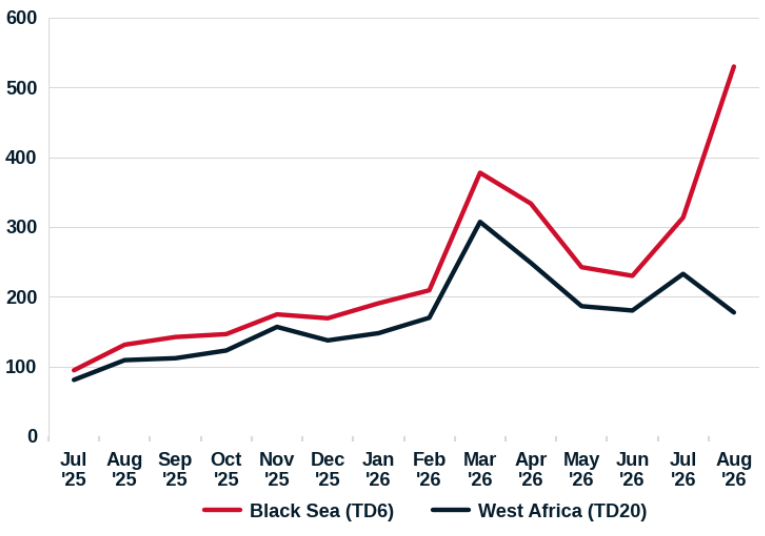
As the security situation has deteriorated, some vessels have gone dark to load. At the same time, the number of vessels working the region has risen, with the growing freight premium drawing more owners into the trade. Others are staying away, deterred by the apparently indiscriminate nature of the attacks. Vessels have been hit despite their owners having no prior involvement in Russian trade, and in some cases despite those owners being domiciled in countries allied to Ukraine. That lack of an obvious pattern has added to the uncertainty. TD6 has risen to over WS530, which equates to around $400,000/day on a round voyage basis, rivalling rates seen in the Middle East. West Africa’s TD20, the Suezmax benchmark, meanwhile, has eased in recent weeks, widening the Black Sea premium to over $300,000/day. Cargo war risk cover for CPC has jumped roughly fivefold in three weeks, from around 0.2% of cargo value to around 1%.
So far restarts have taken mere days, and with Kazakh crude having nowhere else to go at scale, any damage to infrastructure will be repaired as a priority. Yet, disruptions have in recent times lasted longer than anticipated, with last winter’s running to three months. Should attacks successfully strike the SBMs, the port, or the pipeline itself, another relief valve for the global oil market could disappear. Suezmaxes have so far benefitted from the disruption, but any longer-term decline in volumes from yet another outlet could cut both ways. A prolonged campaign striking tankers trying to load at CPC could have a similar effect.
Suezmax Freight Rates – Black Sea vs. West Africa (WS)
Crude Oil
East
The AG and Red Sea VLCC market remained firmly driven by geopolitical developments throughout the week. While a modest increase in enquiry provided some encouragement and prompted a slight uptick in freight levels, momentum ultimately faded as the week progressed, with rates ending largely flat. Fixtures continued to materialise, with a notable number concluded privately, steadily reducing the list without providing a clear indication of market direction. Owners will be hoping for a more sustained flow of enquiry next week to generate fresh upward momentum. Until then, sentiment is likely to remain closely tied to developments in the region, with security concerns continuing to be the primary influence on the market.
For yet another week the Suezmax situation in the Middle East remains as clear as mud. A large portion of owners are simply choosing to ballast via COGH rather than waiting for any potential solution to be found, though there are still a few willing to transit who are cashing in on the premiums for the risk incurred.
The Asian Aframax market has posted gradual gains throughout the week, with the index settling higher on the back of firming rates for replacement and prompt fixtures. The bulk of demand for the second decade of the month has already been met, leaving the market waiting for the next round of cargoes to provide renewed rate support. In the nearby TMX market, most fixtures for late August into September have been concluded and rates remain largely unchanged. However, Typhoon Dolphin is approaching mid-China over the weekend, with vessel schedules already being hit by delays, which could stretch turnaround periods and shrink the effective supply of tonnage for later positions. We assess the next Indo/Up voyage at 80 × WS160.
West Africa
The WAF VLCC market remained subdued throughout the week, with freight levels coming under renewed pressure following the conclusion of a handful of reported fixtures. While the tonnage list continues to offer a range of available vessels, the majority are eastern ballasters, leaving prompt local availability relatively limited. Much of this week’s business was concluded privately, preventing any meaningful momentum from building and offering little transparency on true market direction. Looking ahead, owners will be hoping for a healthier flow of enquiry, while the recent firming in the Suezmax market could encourage charterers to utilise VLCCs for suitable stems, providing some underlying support to sentiment heading into next week.
TD20 has fallen away this week; however, there is a more bullish vibe in the air and many owners are under the impression that the WAF Suezmax market has bottomed. With just shy of WS177.5 done out of Brazil today, owners will be looking to push on next week.
Mediterranean
TD6 has gone from strength to strength throughout the week, with many more owners now unable to call CPC. The list has seen pretty much every ship with a firm itinerary fixed away, and those left with cargoes to cover are in a spot of bother. Rates have pushed up over WS500, and next done owners will be pushing for something over WS530 for sure. In the Med, rates remain steady. Some enquiry from Sidi/Yanbu has spilled over from the VLCCs, though it seems largely question-orientated and little has actually been fixed. With a firm CPC market, expect strong sentiment from owners going into the weekend.
Collective Aframax Med activity over the week has given owners a degree of optimism, especially where the clearout of front-end availability put the brakes on a market in decline. Frustratingly for owners, however, activity levels fell just short of what was needed to claw back some of the lost value, which at one point in the week looked a distinct possibility. Finishing the week, conditions remain stable, with WS245 considered the market rate for a good Libya flat, which is likely to continue into next week, particularly as a number of Med ports appear to be causing delays to itineraries.
US Gulf/Latin America
The USG VLCC market began the week on a subdued note, with freight levels coming under pressure following the recent correction in Brazil. The softer market encouraged a modest increase in enquiry, while a steady stream of business continued to take place under the radar. As the week progressed, the tonnage list gradually tightened, although the pace of enquiry remained insufficient to generate any sustained upward momentum, leaving freight levels largely rangebound. Looking ahead, owners will be hoping for a more visible pickup in enquiry next week to build momentum and test higher freight levels. Until then, the market is expected to remain under pressure.
North Sea
The North Sea Aframax market walked its own path as usual, largely ignoring movements in surrounding areas. This was not entirely true, as we did observe a correction from WS225 levels down to WS215, but this was not a patch on the much more severe corrections seen worldwide. As usual, some owners need to remain local for programme or customer relation reasons, and those are the ships preventing the market from moving too far in either direction. Looking to the coming days, we see rates remaining rangebound.
Crude Tanker Spot Rates (WS)
Clean Products
East
Another week and the conflict continues in both the AG and Red Sea. Some vessels are managing to transit in and out of Hormuz, but of course with the associated premiums. TC5 loading within the AG remains at the WS350-375 level, though loading STS Sohar or Fujairah will be WS195. West runs from Sikka are hovering at $3.0m for UKC via Suez for now, although owners are reluctant to move Saudi oil laden through BEM. LR2s are seeing WS175 for TC1 ex STS Sohar and $4.5m Sikka/UKC. Red Sea trade continues to be difficult, with further attacks on ships off Gizan, though for vanilla Yanbu loads this is still fine for the majority of owners. LR2s are at $3.6m Yanbu/UKC and LR1s at $2.8m. Overall, the market will sit close to these levels for now until something materially changes with the state of the various conflicts.
An active week in the AG MRs, with a steady flow of cargoes throughout continuing to thin the list up to mid-month and keep sentiment firmly with owners. EAFR/SAFR runs remained active, while enquiry ex Fujairah-Sohar-Duqm and WCI saw rates trade steadily upward on and off market. Cross-AG activity also kept workable positions inside Hormuz busy, with uncertainty around some itineraries adding further pressure to the list. The Red Sea traded steadily throughout the week, with West runs seeing a fresh test at $1.95m. With fresh enquiry continuing to surface and tonnage tight nearby, sentiment remains firm heading into next week.
UK Continent
Rates in the UKC MR sector have been a little all over the place this week, with a few stems getting caught out and driving up numbers when least expected. On the flip side, with TC14 crashing down in the second half of the week, owners are now scratching their heads as to which route is preferable. With limited options for Handies, a good number of stems have covered for XUKC and Med/UKC moves, keeping the tonnage list turning over, but with a lack of vessels ballasting to the USG — and some even making a U-turn — options for charterers are opening further. With TA now sitting around the 37 × WS125 mark and WAF sliding from WS220 to around WS180, we wait to see what defences owners can put up next week to prevent further decline.
On the face of it a rather quiet week for the Handy-sized vessels passes, but in reality charterers have been saved from a tight list by the glut of MRs available, which has kept cargoes moving. For those who have had to take a natural 30kt vessel, rates have been at a premium, with arguably the equivalent of 30 × WS250 now on subs, though where MRs can be taken they are trading at WS230. Expect a similar picture moving into next week, with limited vessel turnover but the MRs continuing to hamper any real progression by owners.
Med
MR rates have corrected downward to WS135 off the back of minimal enquiry, with the slow pace of play contributing to bearish pressure throughout the week. With the Black and Red Seas becoming a no-go for some owners, the Med has remained pretty slow, as those with tonnage discharging have had limited backhaul options ex the Med. Eyes on how the list shapes up come Monday, with owners hoping some fresh enquiry can spark new life into this MR sector.
In all it has been a subdued week for Med Handies, with rates remaining largely rangebound within WS220-230. Tonnage displacement favouring the EMed, grade sensitivity coming into play, business going direct and cabotage requirements have somewhat clouded sentiment. It has been very much a position- and itinerary-based market, with owners trying to find the cargoes with the least waiting and least ballast for earnings optimisation amid the ebb and flow of enquiry. As a whole, however, with limited fixing activity despite some under-the-radar dealings, the lack of visible momentum is contributing to a softer market tone and could strengthen charterers’ position in the longer term.
Clean Tanker Spot Rates (WS)
Dirty Products
Handy
The week began with tight UKC tonnage availability and limited replenishment over the weekend, supporting firmer sentiment and rates around WS315-320. By mid-week, naturally positioned tonnage remained scarce this side of mid-month, with WMed units likely to be required should enquiry levels increase, pushing indications toward WS322.5-327.5. As the week draws to a close, some forward fixing has been observed, a trend expected to continue as the list remains tight for natural dates. Sentiment ends the week on a firm footing, with rates indicated around WS330-335.
The Med has steadily trended upward this week, with under-the-radar dealings clipping tonnage from the list. Owners have pushed on to WS360, which is reported to have been repeated multiple times. As we close out the week, the list looks tighter than it first appears, with some units not workable to all and a handful of relets that may soon head into programme. Should this unusually busy summer period continue into next week, levels could climb higher, but for now we head into the weekend on rather stable footing.
MR
MRs started the week with thin naturally placed availability, leaving charterers looking toward WMed for reinforcements and supporting firm sentiment, with rates around WS250-260. Throughout the week there was little activity, with a fresh test still needed; however, given the strength of the Handy market and the lack of available options, rates were expected to push upward, with indications around WS255-260. Ending the week, a number of workable second-decade options have emerged, though a fresh test is needed and sentiment is expected to remain firm, with rates around WS265-270.
The Med started the week in need of a fresh test, although sentiment remained firm on the back of ongoing strength in the Handy market, with expectations around WS260-270. Tonnage remained relatively thin throughout across varying dates, and owners were anticipated to push for higher levels if called upon. To close the week, while the market remains untested, support from the Handy sector persists and rates are expected to remain around WS265-270.
Panamax
TD21 has seen a week of relative quiet, following a similar trend to the wider local markets. Previous weeks’ activity has thinned out availability, helping to support levels and slow the softening of ideas to around 50 × WS350. Over on this side of the Atlantic, UKC-USG runs have seen some interest, with one fixture reported though details remain unconfirmed. We currently see a handful of workable ships in the North and ex DD tonnage down in the Med, with levels for UKC-USG runs around the 55 × WS190-200 mark as things stand.
Dirty Product Tanker Spot Rates (WS)
Rates & Bunkers
Clean and Dirty Tanker Spot Market Developments – Spot WS and $/day TCE (a)
| wk on wk change | Aug 06th | Jul 31st | Last Month* | FFA Q3 | |
| TD3C VLCC AG-China WS | 51 | 476 | 424 | 345 | 382 |
| TD3C VLCC AG-China TCE $/day | 59,500 | 505,750 | 446,250 | 361,500 | 391,000 |
| TD20 Suezmax WAF-UKC WS | -50 | 172 | 222 | 233 | 209 |
| TD20 Suezmax WAF-UKC TCE $/day | -29,750 | 77,750 | 107,500 | 118,250 | 94,250 |
| TD25 Aframax USG-UKC WS | -68 | 307 | 375 | 190 | 290 |
| TD25 Aframax USG-UKC TCE $/day | -23,750 | 84,250 | 108,000 | 42,000 | 72,000 |
| TC1 LR2 AG-Japan WS | 26 | 523 | 497 | 361 | |
| TC1 LR2 AG-Japan TCE $/day | 8,500 | 148,750 | 140,250 | 98,750 | |
| TC18 MR USG-Brazil WS | -121 | 225 | 346 | 329 | 267 |
| TC18 MR USG-Brazil TCE $/day | -21,000 | 23,500 | 44,500 | 43,500 | 28,250 |
| TC5 LR1 AG-Japan WS | 23 | 542 | 519 | 359 | 382 |
| TC5 LR1 AG-Japan TCE $/day | 5,750 | 110,500 | 104,750 | 69,250 | 68,750 |
| TC7 MR Singapore-EC Aus WS | -8 | 260 | 269 | 286 | 241 |
| TC7 MR Singapore-EC Aus TCE $/day | -1,500 | 25,000 | 26,500 | 32,250 | 21,000 |
(a) based on round voyage economics at ‘market’ speed, eco, non-scrubber basis
Bunker Prices ($/tonne)
| wk on wk change | Aug 06th | Jul 31st | Last Month* | |
| Rotterdam VLSFO | -52 | 632 | 683 | 601 |
| Fujairah VLSFO | -35 | 775 | 810 | 723 |
| Singapore VLSFO | +14 | 817 | 803 | 463 |
| Rotterdam LSMGO | -178 | 1119 | 1,297 | 1,018 |