Contents
Clean Slate?
The US is weighing a waiver that would let tankers sanctioned for links to Russia, Iran or Venezuela carry non-sanctioned oil, or be sold to mainstream owners, in a bid to bring down record freight rates and move more crude and products out of the Middle East Gulf. US Energy Secretary Chris Wright has said high freight has hurt demand for US crude. Owners would apply to the US Treasury, cases would be reviewed individually, and the waiver would cover the ships, but not Russian or Iranian oil.
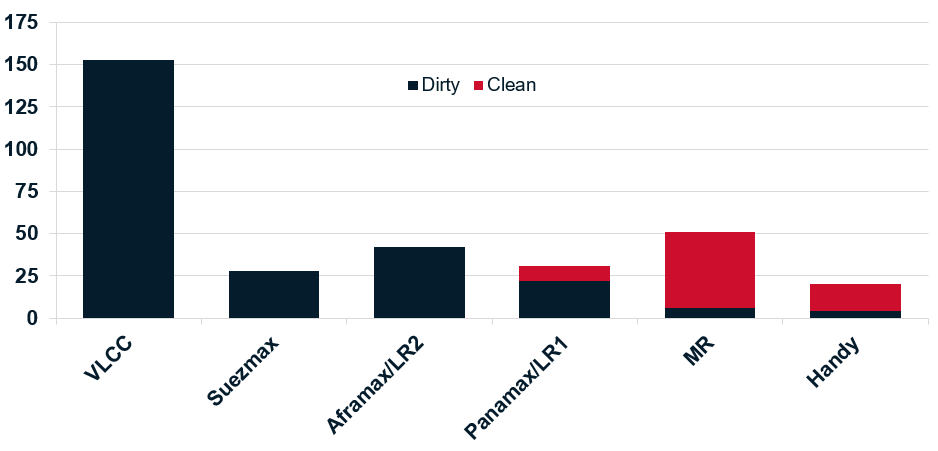
Some 878 tankers, 15% of the trading fleet, are under sanctions, rising to 25% for Aframax/LR2s. The US can only waive its own designations, however, and EU and UK cooperation looks unlikely. That leaves 325 tankers listed by OFAC alone as the possible pool, and 153 of them are VLCCs, covering almost all of the 164 sanctioned VLCCs. Only 28 of the 116 sanctioned Suezmaxes and 42 of the 322 Aframax/LR2s are OFAC-only, and clean tonnage is limited, as around 40 CPP MRs, mostly in the East, potentially available for mainstream trade.
84% of OFAC only tankers are in the Middle East, Indian Ocean or Far East, with just 16 individual ships in European waters, so any direct impact would be felt East of Suez. Atlantic charterers would benefit only indirectly, if sanctioned tonnage takes market share in the East and pushes more mainstream ships to ballast West.
Iran directly owns 64 sanctioned vessels of which 38 VLCCs, and more are possibly held by Iranian interests in other jurisdictions. Where links to the IRGC exist, OFAC may be reluctant to grant waivers. Chinese and Hong Kong owners hold a further 43, which could in theory look to trade in the Middle East.
70% of OFAC-listed tankers are 20 years or older, including 120 of the 163 VLCCs. The conflict has made age less of a barrier, but without IG P&I cover and IACS class, few charterers will be able to take these ships. Their most likely employment is on Hormuz shuttle runs, where the recent increase in attacks has constrained supply. Iranian-linked vessels may be less exposed to attack, though the US Navy will be monitoring for any ship trying to breach the blockade.
Mainstream buyers could also seek approval to purchase sanctioned tonnage, and the extra ships available could weigh on secondhand values. Russian exporters may face higher freight costs if some of their trading tonnage is drawn into Middle East business. The length of any waiver matters too, as a short-term reprieve may not be enough for charterers to commit to longer voyages, and the risk of renewed tensions after next month’s midterm elections may further limit appetite.
The waiver could add capacity to the Hormuz shuttle trade in particular and could have some freight impact across the wider market. Most of the tonnage it could add is old, mostly VLCCs, sitting East of Suez. Since any delisting would follow OFAC’s usual full review, it may take time for a significant number of ships to be freed for mainstream trade. The TD3C VLCC FFA market has corrected downwards over the past couple of days, in part due to this news. In the end, the number of waivers given out will decide whether any impact is felt at all.
OFAC-Only Sanctioned Tankers by Trade (Vessels)
Crude Oil
East
The AG/Red Sea VLCC market started the week on a firm footing, although the overall pace of enquiry gradually slowed following the stronger activity seen in previous weeks. With limited fresh cargoes emerging, the tonnage list has remained relatively balanced through to the end of October, while some vessels continued to disappear through some under-the-radar fixtures. Despite the quieter conditions, owners have maintained a firm stance, with freight levels holding steady throughout the week. Recent developments in the Atlantic might influence the market, as more vessels may look to ballast west if stronger opportunities persist. Looking ahead, owners will be hoping for a recovery in enquiry to maintain current levels, with a fresh test needed to assess whether the market can sustain rates for next week.
The Suezmax market in the AG is starting to stall, and even those capable of loading Fuj are still choosing to ballast west due to lower levels of enquiry. Expect rates to soften a touch.
The Asia Aframax market experienced slower activity this week, with rates appearing to have peaked. TD14 concluded below expectations, potentially signalling the beginning of a shift in bargaining power back to charterers, particularly if November cargo volumes continue to emerge at a measured pace. Adjacent markets have followed a similar trend: TMX TD28 appears to have peaked earlier this week and has recently moved lower, in line with the rapid decline observed in the West. Market softness may persist into next week if cargo flows remain subdued, and we assess the Indo/Up route to soften as well, with rates trending towards 80 × WS820-825.
West Africa
The WAF VLCC market has experienced a quieter week, with very limited fresh enquiry reported across the region. Following the firmer levels done at the end of last week, activity has failed to maintain momentum, leaving freight increasingly exposed to developments in the surrounding Atlantic markets. The tonnage list remains somewhat challenging for natural dates, with several owners favouring longer voyages in the West. However, recent fixtures in these neighbouring markets have begun to correct, gradually putting downward pressure on WAF rates despite the relatively balanced tonnage position. With little fresh activity to clarify current levels, owners’ confidence may be tested further if the Atlantic continues to soften. A fresh fixture will be needed to establish where freight stands as we move into next week.
Marketed Suezmax enquiry in West Africa this week has been relatively quiet, but of course under-the-radar enquiry continues to pick off tonnage. This has left the close of this week with a softer feeling, with larger tonnage continuing to offer a better $ per ton. Nevertheless, tonnage availability in the Atlantic is pretty date-dependent and can still be difficult to cover firm enquiry, depending on dates. This leaves the volume of enquiry in early trading next week critical as to whether we will see charterers try to chip rates for TD20 under the WS900 mark.
Mediterranean
Enquiry from CPC has remained buoyant this week, where midweek we witnessed a flurry of enquiry. As a result, fixing levels hit a high of WS1150 for TD6; however, looking into this, once again dates played a large part in giving owners the opportunity to push on levels. Looking ahead, we feel their high may be hard to repeat, and levels should settle down next week.
Afra Owners are left to ponder how best to manage their expectations this week, in what’s been an unusually bearish period if recent cycles are anything to go by. A combination of the US reacting to a correction in forward paper and availability being tilted in charterers’ favour saw the Med begin to soften. In recent quieter cycles, owners have resisted attempts to lower levels, largely ignoring underlying fundamentals, but this time competition for cargoes has been more intense, despite larger sizes remaining resiliently firm.
This slump may yet prove to be just a blip, as currently the Aframax offers a much better $/MT if you can move an 80kt slug rather than a Suezmax. It remains to be seen how many actually have the ability to do this. With November dates almost upon us, one gets the feeling it won’t take much to reverse the momentary reprieve charterers are enjoying.
US Gulf/Latin America
The States VLCC market entered the week after strong freight levels, including a USG/Far East fixture reported at $81m. However, the overall pace of enquiry remained relatively subdued, with the Columbus Day holiday contributing to a particularly slow start. As the week progressed, Brazil continued to provide much of the visible activity, with Petrobras attracting a reasonable number of offers as more owners began favouring Atlantic loadings. Despite some activity taking place under the radar, recent fixtures have indicated a significant correction from previous highs, putting further downward pressure on freight across the Atlantic basin. The increasing availability of interested tonnage, combined with limited fresh enquiry, has gradually weakened owners’ position and reduced confidence in maintaining the higher levels seen previously. The market therefore ends the week on a softer note, with charterers potentially pushing further below last done, while owners will hope for renewed enquiry to prevent further erosion in rates heading into next week.
The Americas Suezmax market has followed the quiet trend of WAF this week, with limited enquiry to report on. A couple of Guyana stems in the early part of the week managed to give owners something to get their teeth into, resulting in WS1000 being reported for TD27. This is said to be because surrounding-size tonnage has been in favour this week, which has left the Suezmaxes lagging behind.
North Sea
After the fun and games of last week, this week seemed relatively muted in comparison. Tonnage started to build up as the amount of transatlantic ballasting was reduced due to less demand in the United States. The list now holds plenty of local players, and we’ve seen this come to fruition in the rates. It feels like there are still a few more points to shave into the early part of next week, and the usual players will be the ones to do so.
Crude Tanker Spot Rates (WS)
Clean Products
East
Massive rates seen on both the LR2s and LR1s this week: 75 × WS725 on TC1 and 55 × WS600 on TC5. However, as seen in the past, when such large rates go either on subs or get fixed, it can tend to stall the market, as charterers understandably become reluctant to move unless necessary. This has very much been the case for the latter part of the week. Some owners’ ideas are still very much pushing hard, which, given how tight both lists are, could seem fair; however, some are very much looking at the cost of waiting days and are therefore up for a discussion on where the next done will be if they minimise their waiting. Next week should be very busy as the first-decade stems make an appearance and charterers want to cover in such a volatile market.
The AG MR market has softened over the course of the week, with TC17 slipping from WS605 to WS565 and TC12 easing to WS440, as prompt tonnage continued to weigh on sentiment. Despite the downward pressure, a steady flow of cargo enquiry and a number of outstanding requirements heading into end-month have kept owners optimistic. LRs continue to strengthen on the back of tight lists and healthy cargo flow, with potential for some trickle-down support into the MRs. As we close the week, owners will be hoping for a tighter list and a rebound in levels as we move into the next fixing window.
UK Continent
This week has been somewhat of a reality check, as for weeks now the market has been driven by fever-pitch, wider-market bullish sentiment, largely driven by other sizes and geopolitics. It is unusual to see rates softening into this month, as usually weather factors and seasonal demand have well and truly kicked in. Numerous vessels are now ballasting to the USG for better returns, so we may now be entering the yo-yo stage of a void of tonnage in the UKC and Med and lots in the USG, which would obviously mean that when there is some action, rates will bounce back quite hard and fast.
A week which started with some hype, and handy owners were digging in and looking to hold the line at last done levels (30 × WS330). However, with an inactive MR market, those with ships in play started competing on 30kt short-haul stems, resulting in freight softening by 10 WS points to 30 × WS320. This number has been repeated a couple of times now, and the issue is that those fixed for short will only be resurfacing back on our tonnage list in the short term. UKC/Med remains an attractive run, with TC6 once again showing its volatility, but volumes have slowed a touch this week. Handies very much at the mercy of the MR sector for now.
Med
With geopolitical developments earlier in the week, large paper positions, and LR stems parcelling down drawing in MRs, sentiment was bullish, with most of the mind that rates were to rise. Additionally, as the Med-East naphtha/condensate dynamic remained and ships were fixing this route, tonnage was seen to be thin on the ground. However, all this never quite came to fruition to push Med MR rates drastically. Now, with TC14 bouncing and the North stalling, it seems owners have been assessing cargoes case by case, with the emphasis on positions, grades, itineraries, and dates. Med-TA remains sideways at the WS215 mark, with a straight TA stem likely to be discounted. Where we have seen more volatility is on short-haul runs, as owners try to line up a suitable run to get them to a firming USG market or capitalise on a Med-East run. It is thought that XMed, WAF, and UKC runs ex the Med could continue to test upwards from where they sit currently at WS300, WS300, and WS295 respectively, in response to a firm USG.
A firm week passed for Med handies. From the get-go, sentiment was firm, given we saw an active Monday regarding enquiry. Fixing activity soon followed suit, which led to the list tightening, and thus the market hit critical mass and owners assumed control. Large jumps from WS360 to WS390 and then WS415 over a three-day period gave charterers little time or opportunity to wrestle initiative back off owners. Business then shifted under the radar in an attempt to cool the market off, but we now sit at the WS445 mark. We expect this momentum to continue as long as the supporting fundamentals, such as limited well-approved tonnage and regular enquiry, remain constant, making the weekend restock a pivotal factor. Moreover, weather is another factor to watch, especially for any unfirm itineraries, which could further complicate matters.
Clean Tanker Spot Rates (WS)
Dirty Products
Handy
A handful of prompt vessels remained on the list, creating some competition amongst owners and leaving rate expectations around WS345-350. It was evident early on that it would not take much to tighten the list, and a number of vessels were quickly clipped away, allowing rates to firm towards WS360-365. A handful of units then failed subs, while several cargoes were also understood to remain uncovered. With naturally placed tonnage now thin, owners continue to hold the upper hand, with the next done expected around WS365. Even at these levels, UKC remains at a notable discount to the Med, making meaningful WMed ballast reinforcement unlikely.
A bit of a Mexican stand-off developed between owners and charterers, with owners initially reluctant to call the market and rate ideas starting around WS400. It did not take long for activity to pick up, however, with a flurry of stems driving a 50-point jump. Although the position list carried a noticeable WMed skew, the flow of enquiry was sufficient to absorb the additional tonnage, allowing rate ideas to firm towards WS450-460. The list now looks increasingly thin, although some relief has come from a handful of vessels failing subs. Despite this, owners are expected to continue firming their ideas, with expectations to push from WS470.
MR
Sentiment carried over from the previous week, with rate ideas initially around WS320-330. Expectations were for ideas to firm further, as stronger Med earnings could incentivise owners to ballast south, although this has yet to materialise in any meaningful way. As the week developed, rate ideas moved higher towards WS350-360, with owners expected to continue trying to close the gap to Med levels when called upon. Despite this, a well-publicised test failed to emerge, leaving the market without a clear benchmark. Looking ahead, expectations remain that owners will continue to consider ballasting south to take advantage of the stronger earnings available.
Reports of cargoes emerged almost immediately, driven by the strength of the Aframax market and the continued splitting of stems, with initial rate ideas around WS350. With the list already looking tight, continued fresh enquiry quickly pushed levels higher, resulting in WS420 being concluded and subsequently adopted as the new benchmark. Availability has since thinned further, leaving owners firmly in the driver’s seat and expected to keep their foot on the gas. While the significant differential between UKC and Med earnings could attract some ballast reinforcement from the North, for now rate ideas continue to advance and are seen around WS440-450. We will now see if MR rates can continue to drive on the back of a softer Aframax market.
Panamax
Rate ideas remained firm throughout the week, supported by the strength seen in surrounding markets and the limited amount of available tonnage for the month. Levels were generally seen around WS370-380 by midweek, although activity remained largely dependent on cargoes falling on owners’ dates. Strong USG earnings continued to incentivise owners to ballast back rather than wait around for backhaul opportunities, despite TD21 showing some signs of softening.
As expected, the market started quietly following the Federal holiday and various industry events, although sentiment continued to favour owners, with rates around WS725-735. For the first time in a while, however, levels began to steady, and the market started to look a little toppy as activity slowed, leading to rates easing towards WS685-695. There was also a feeling that some under-the-radar activity may have been taking place. Nevertheless, earnings remained highly attractive by historical standards, with rates ending the week around WS670-680.
Dirty Product Tanker Spot Rates (WS)
Rates & Bunkers
Clean and Dirty Tanker Spot Market Developments – Spot WS and $/day TCE (a)
| wk on wk change | Oct 15th | Oct 8th | Last Month* | FFA Q4 | |
| TD3C VLCC AG-China WS | -38 | 1,281 | 1,319 | 1,140 | 1,138 |
| TD3C VLCC AG-China TCE $/day | -44,750 | 1,433,750 | 1,478,500 | 1,270,250 | 1,257,500 |
| TD20 Suezmax WAF-UKC WS | -61 | 920 | 981 | 454 | 666 |
| TD20 Suezmax WAF-UKC TCE $/day | -39,500 | 550,750 | 590,250 | 252,750 | 379,500 |
| TD25 Aframax USG-UKC WS | -200 | 756 | 956 | 459 | 631 |
| TD25 Aframax USG-UKC TCE $/day | -76,000 | 249,000 | 325,000 | 136,750 | 194,750 |
| TC1 LR2 AG-Japan WS | 57 | 986 | 928 | 826 | |
| TC1 LR2 AG-Japan TCE $/day | 18,250 | 300,250 | 282,000 | 247,750 | |
| TC18 MR USG-Brazil WS | 106 | 460 | 354 | 274 | 354 |
| TC18 MR USG-Brazil TCE $/day | 19,250 | 64,000 | 44,750 | 30,000 | 41,500 |
| TC5 LR1 AG-Japan WS | 41 | 982 | 941 | 843 | 924 |
| TC5 LR1 AG-Japan TCE $/day | 9,250 | 215,250 | 206,000 | 182,000 | 197,250 |
| TC7 MR Singapore-EC Aus WS | -20 | 550 | 570 | 444 | 416 |
| TC7 MR Singapore-EC Aus TCE $/day | -4,000 | 72,250 | 76,250 | 54,500 | 47,500 |
(a) based on round voyage economics at ‘market’ speed, eco, non-scrubber basis
Bunker Prices ($/tonne)
| wk on wk change | Oct 15th | Oct 8th | Last Month* | |
| Rotterdam VLSFO | +34 | 733 | 699 | 724 |
| Fujairah VLSFO | +23 | 978 | 955 | 1,013 |
| Singapore VLSFO | +23 | 903 | 881 | 903 |
| Rotterdam LSMGO | +47 | 1375 | 1,328 | 1,505 |