Contents
Cracks are showing
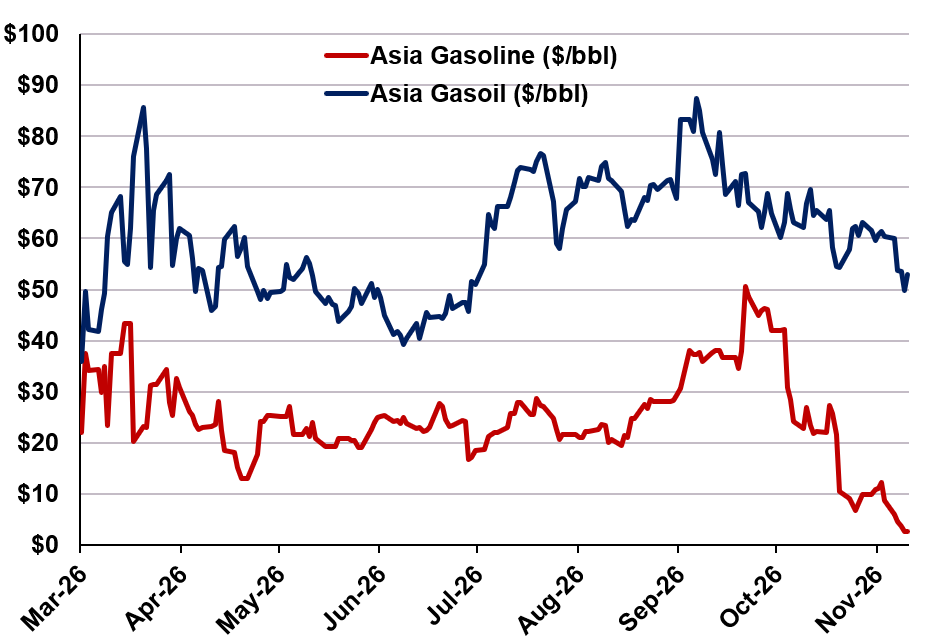
Refining margins have fallen sharply this month, led by gasoline. Asian gasoline cracks stand at just over $1/bbl, close to negative, the lowest in more than three years and a stark drop when compared against more than $50/bbl at the start of October. Gasoil is holding up better but is well off its highs, Asian cracks are near $53/bbl, down from $87/bbl in mid-September, and European gasoil has dropped to $61/bbl. Refineries are still running hard to capture those margins, and gasoline, produced alongside regardless, is paying the price. Utilisation remains high, in the US for example, the thin autumn maintenance program we flagged in August (No Margin for Error) kept utilisation at 95.6% in October, against 90.6% in the previous two years.
These lower margins are leaving refiners less room to pay for freight, especially in the East. Record product cracks allowed record crude freight to be absorbed in September and October, but with margins now lower, that cost has to fall elsewhere. Freight has already taken part of the adjustment, with VLCC earnings from the Gulf to China around a quarter below their October peak, and sellers are bearing more of the remainder. Saudi Aramco has cut its December Arab Light price for Asia to a discount of $7/bbl, a six-year low, and Iraq is again offering Basrah crude at discounts of more than $30/bbl for loading inside the Gulf. If margins stay weak, freight may need to fall further to restore the balance, which could limit how far crude tanker rates can recover from the recent correction.
Clean tanker rates outside the Gulf have moved decidedly lower. In the West, MRs from the US Gulf have dropped sharply, on a TCE basis now around $26,000/day, down around two thirds since late October. LR2s from the Mediterranean to the Far East (TC15) are at $60,000/day against $175,000/day in mid-October. In the East, MRs between Singapore to Australia (TC7) have dropped to just over $40,000/day from highs of $74,000/day. Gulf freight rates, where war risk sets the price, have held up comparatively well.
Preliminary numbers show seaborne clean exports reaching 18.4 mbd in October, about 5% below the 2025 average. Gulf refinery runs appear to be picking up, which may explain part of the recent fall in crude exports. However, this is not yet visible in product loadings, and so far November data show little improvement, though subject to revisions.
We see around 12% of the Aframax/LR2 fleet trading clean, near record lows. MRs have filled the gap, which lifted 55% of all clean cargo in October against 48% in 2025. Arguably little has supported clean tanker earnings more this year than dirty ups, and with dirty earnings still well above clean in most regions, that support does not yet seem at risk. Meanwhile, so far 116 MRs and 73 LR2s have delivered this year, more than in all of 2025, with a further 163 MRs (8% of the fleet) and 82 LR2s (11% of the fleet) scheduled to deliver between now and the end of 2027. We estimate that the recent surge in vessel attacks, especially in and around the Strait of Hormuz, has seen around 15 clean tankers attacked in October and early November, taking some capacity out of the market, at least temporarily.
Another factor to watch is China. Chinese CPP exports fell by around a quarter in October from September’s 1.1 mbd to around 850kbd. There are close to 16 million tonnes of quota left for the final two months, and November export plans are up 25%. However, so far preliminary clean export volumes are down, with loadings in the first half of the month running below October, and with landed refining margins this narrow the plans may not be met in full.
For clean tankers, weaker margins could threaten both sides of the balance; fewer cargoes if refiners trim runs, and more ships if LR2s return from dirty trades. Demand projections have been drifting lower, with the IEA now seeing gasoline and diesel demand in 2027 around 1 mbd below 2025 levels. Deferred US maintenance is likely to fall in the first half of 2027, when El Niño could bring renewed Panama Canal restrictions and tighten MR supply in the Americas. For now, much rests on how many LR2s stay dirty, how much of its quota China uses, the potential of disruptive winter weather, and whether higher Gulf refinery runs start to show up in product exports.
Refining Margins ($/bbl)
Crude Oil
East
The AG and Red Sea VLCC market remained relatively active throughout the week, with cargoes regularly looking for cover and tonnage gradually tightening compared with the previous week. Rates softened slightly during the week before edging up towards the end, supported by stronger activity in the Brazil/East market. Owners have become more confident, although it remains to be seen whether the recent increase in levels can be sustained.
The Suezmax AG market remains driven by geopolitical developments, while firmer USG and Guyana earnings may tempt more owners to ballast West. Any increase in westbound ballasting could thin the forward AG list.
In Asia, the Aframax market ends the week on a relatively quiet note, with some activity helping to trim the tonnage list, though overall trading remained subdued. Market conditions remain largely unchanged from previous sessions, with few fresh developments to provide direction. TD14 continues to slip, with earnings now around $111,000/day, as participants look towards next week for a stronger flow of cargoes to test prevailing levels and potentially establish a new floor. We close the week soft, assessing Indo/Up at 80kt × WS400.
West Africa
The WAF VLCC market remained largely inactive throughout the week, with very limited fresh enquiry despite some early signs of a tightening tonnage list. Recent activity in the Atlantic pushed rates slightly lower, but this was not enough to bring charterers back to the VLCCs. Suezmaxes continue to offer better value, keeping most enquiry on smaller sizes and leaving the VLCC market waiting for a fresh test.
WAF Suezmax enquiry remains quiet, but a burst of USG activity, supported by a firming Aframax market and steady Guyana demand, has pushed Atlantic Suezmax rates higher and tightened the tonnage list. The focus now is whether enquiry holds up once the pre-Thanksgiving rush subsides.
Mediterranean
The Med/CPC Suezmax list has tightened as stronger Atlantic activity has absorbed competing tonnage. A handful of itineraries are still to firm and some stem cancellations are expected, so next week should give a clearer read on the balance of tonnage and firm enquiry.
Mediterranean Aframax rates have been on the move this week. As we came to a close last Friday the seeds were sown, as a number of cargoes mopped up the stragglers at last done levels and shoots of recovery became apparent. As the gates opened this week, owners started to push for more points and normal cross-Med runs moved from the WS260s up to WS285. The perfect storm was then created, with US exports injecting huge volumes into the market and giving Med owners further hope. Rates moved to WS310 and then WS350, with a high of WS400 concluded for a very short run. Given TD25 levels have grown almost 100%, there is a solid base for owners to push, and WS390 was achieved for a decent flat rate voyage by the close. Looking forward, a cocktail of bad weather, port delays, firming Suez rates and a healthy USG market means these elevated levels are here to stay for now.
US Gulf/Latin America
USG VLCC enquiry remained extremely slow throughout the week, with most activity focused on smaller sizes as Suezmaxes and Aframaxes continue to be better priced. Some increased activity in the South and stronger Brazil exports provided a positive signal for owners, but this has yet to translate into meaningful VLCC enquiry in the USG. For now the market remains quiet and is likely to need a fresh cargo to establish a clearer direction.
North Sea
Finally a bit of growth in the North Sea Aframax market, following on from a booming US market and continued bad weather. As always, the North plays second fiddle and takes a while to catch up with its neighbours, but plenty of units were clipped away this week, leaving a much more trimmed list. Most see this optimism continuing into next week, with further growth on the cards. Owners find themselves in the driving seat, and many think this could be short lived and will take their opportunities whilst they can. Near term gains are still expected.
Crude Tanker Spot Rates (WS)
Clean Products
East
Although on the outside it would appear to have been a quiet week for the LRs, off-market and direct deals have been plentiful, and owners will be thankful as the front of the lists looks more balanced heading into the weekend. Big negative corrections have been seen on rates, with 55 × WS300 for TC5, and owners will be hoping the floor has been realised and that as we enter the next window stems will come and they can push rates. That said, momentum is very much in favour of charterers, and they will want to keep it this way.
A sluggish start to the week for MRs saw limited fresh enquiry and an increasingly well-stocked tonnage list weigh on sentiment. Rates came under further pressure on Tuesday afternoon, with TC17 tested down to WS500 ex Duqm, while a weakening Singapore market saw more owners turn towards WCI/AG employment. The downward trend continued through Wednesday, with TC17 eventually slipping to WS432.5. Thursday and Friday saw a further drop in visible activity, with much of the business concluded off-market. With ballast tonnage continuing to build, the market looks set to remain under pressure heading into next week.
UK Continent
Negative correction has been the theme for MRs plying their trade in the UKC, with owners pleased to see the back of this week. A lack of TC2 and WAF stems, partnered with falling USG markets, has seen 60-odd points wiped off certain routes, with some fresh negative tests still required on others. Natural 30kt clips still offer owners some short term employment, but this only builds the back end of the tonnage list, and unless enquiry picks up early next week before Thanksgiving, this negative sentiment will continue to cloud any Christmas aspirations owners may have.
The lack of fixing has been a concern for Handy owners this week, with a few more ships now surfacing on the tonnage list. MRs are still mopping up a healthy amount of volume, and on Thursday we saw XUKC soften to 37 × WS267.5, meaning Handy owners will have to start adjusting their ideas down or continue to be priced out by the bigger ships. Pressure is building on owners here.
Med
A tale of two halves for Med MRs, as the week started slow with little enquiry and charterers staring down a long list. Tonnage was slowly fixed away, largely on options stems, which somewhat dictated the market this week. As we neared the weekend, a flurry of activity saw rates solidify, with owners hopeful new floors have been found. Eyes on how owners’ ambitions develop next week with the USG softer, though it is thought we could start slowly given the flood of activity over the last two days.
Gradual downward corrections were seen throughout the week for Med Handies, as owners’ appetite to challenge rates was held at bay. Enquiry drip-fed into the market, a relatively healthy list and pressure from larger MR units have all contributed. Whilst we have seen some replacements, weather impacts have not been drastic enough to cause concern for charterers. Eyes on how the list shapes up next Monday and the impact of continued bad weather, though if the pace of play is maintained, charterers could grow further in confidence here.
Clean Tanker Spot Rates (WS)
Dirty Products
Handy
The UKC started the week on a firm footing at WS475-480. Some naturally placed vessels were expected to be available after replenishment, but the list came in short and stayed tight. Owners were quick to push, and early enquiry soon took ideas up to WS480-485. By mid-week, naturally placed units with firm itineraries were thin on the ground, and steady enquiry clipped away the modern units at the top of the list. With the top of the list cleared, charterers have started looking to forward dates for cover. Rates firmed to WS490-495 by the end of the week. Heading into next week, few solid units remain and owners are expected to keep pushing.
The Med opened the week firm at WS480-485. Replenishment came in lighter than expected and skewed to the WMed, which did little to ease the situation toward the top of the list. WS480 was done a few times early on before owners looked for more. The surface turned quieter as the week progressed, but under-the-radar activity kept clipping away at the list, and WS485 repeated several times. Tonnage is tighter still by week’s end, with rates assessed at WS490-495. Heading into next week, owners will be driving for more on next done, and WS500 is in sight.
MR
The week started with both the UKC and Med needing a fresh test. In the UKC, ideas stood at WS375-380, with a couple of available units keeping owners’ ideas somewhat in check. The Med sat at WS440-450, with full-stem enquiry slow to emerge. As the week progressed, options thinned on both sides. Solid UKC itineraries became touch and go, and reported fixtures firmed levels to WS385-390. In the Med, tight supply and a strong rebound in local Aframaxes lifted ideas to WS450-460. Heading into next week, UKC owners will have higher rate expectations, and the firmer Med Aframaxes are expected to bring back interest in 80kt stem splitting. A fresh full-stem test is still needed to determine true levels.
Panamax
UKCM-TA started the week at WS210-220, after softening Aframax rates had weighed on this market. Supply was concentrated in the Med, with a couple of options at the end of the second decade and few units after that. The market looked to the Aframaxes for guidance, and once Med Aframaxes rebounded mid-week, Panamaxes followed suit, with ideas moving up to WS250-260. By week’s end, levels are assessed at WS270-280 for end-month dates, although there still seems to be little appetite on the surface. Heading into next week, firming local Aframaxes should keep owners’ ideas buoyant.
CBS-USG started the week steady at WS670-680, with rates holding at the elevated levels seen at the end of last week. As surrounding markets found support, the expected downward pressure was relieved, and by mid-week the market had started to firm. Activity quietened later in the week, but the market held its ground at WS700-710, with TD21 at WS702.50. Fundamentals remain unchanged, and heading into next week owners are expected to keep a bullish stance.
Dirty Product Tanker Spot Rates (WS)
Rates & Bunkers
Clean and Dirty Tanker Spot Market Developments – Spot WS and $/day TCE (a)
| wk on wk change | Nov 19th | Nov 12th | Last Month* | FFA Q4 | |
| TD3C VLCC AG-China WS | 1 | 1,016 | 1,014 | 1,208 | 1,081 |
| TD3C VLCC AG-China TCE $/day | 1,500 | 1,130,000 | 1,128,500 | 1,347,500 | 1,196,750 |
| TD20 Suezmax WAF-UKC WS | 23 | 331 | 307 | 731 | 531 |
| TD20 Suezmax WAF-UKC TCE $/day | 17,250 | 177,250 | 160,000 | 429,250 | 297,250 |
| TD25 Aframax USG-UKC WS | 302 | 597 | 294 | 652 | 582 |
| TD25 Aframax USG-UKC TCE $/day | 116,000 | 192,250 | 76,250 | 209,250 | 180,000 |
| TC1 LR2 AG-Japan WS | 33 | 1,049 | 1,017 | 1,075 | |
| TC1 LR2 AG-Japan TCE $/day | 10,750 | 323,750 | 313,000 | 329,250 | |
| TC18 MR USG-Brazil WS | -172 | 296 | 468 | 453 | 398 |
| TC18 MR USG-Brazil TCE $/day | -30,750 | 35,250 | 66,000 | 62,000 | 50,500 |
| TC5 LR1 AG-Japan WS | -13 | 993 | 1,006 | 1,105 | 923 |
| TC5 LR1 AG-Japan TCE $/day | -3,250 | 220,000 | 223,250 | 244,750 | 199,250 |
| TC7 MR Singapore-EC Aus WS | -121 | 392 | 513 | 589 | 491 |
| TC7 MR Singapore-EC Aus TCE $/day | -20,750 | 46,750 | 67,500 | 78,250 | 62,500 |
(a) based on round voyage economics at ‘market’ speed, eco, non-scrubber basis
Bunker Prices ($/tonne)
| wk on wk change | Nov 19th | Nov 12th | Last Month* | |
| Rotterdam VLSFO | -46 | 688 | 734 | 747 |
| Fujairah VLSFO | -43 | 808 | 851 | 967 |
| Singapore VLSFO | +12 | 839 | 827 | 926 |
| Rotterdam LSMGO | -86 | 1126 | 1,213 | 1,401 |