Contents
Crude Correction
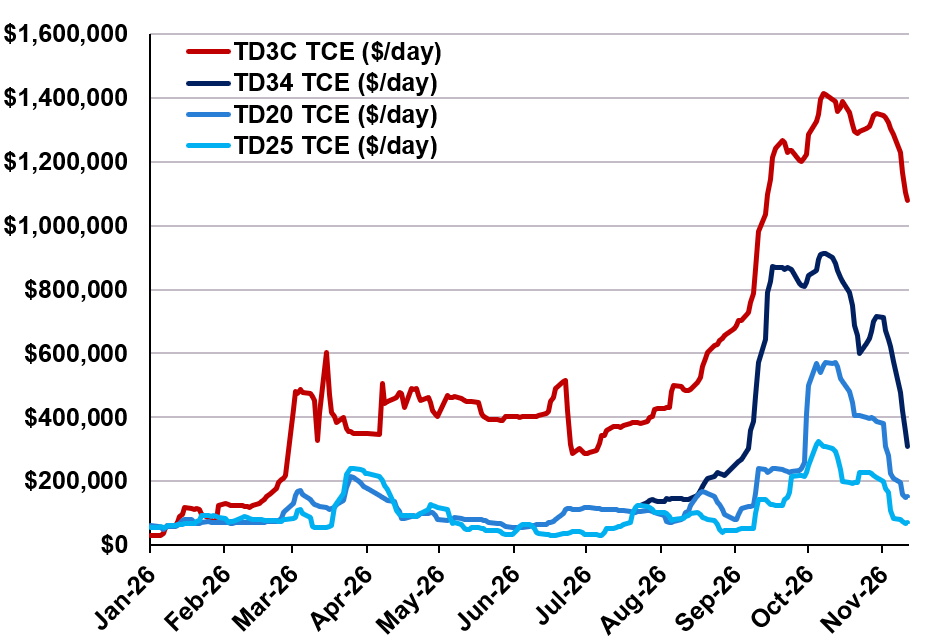
Crude tanker freight rates have taken a beating this month albeit from unprecedented highs, with key benchmarks dropping more than 50%. The rout started following the Democratic wins in the midterm elections, whilst a more de-escalatory tone from President Trump shifted sentiment in financial and commodity markets. Given the surge in freight rates seen this year was not driven purely by quantifiable factors, it is easy to blame sentiment for the fall in tanker rates. Undoubtedly this was a major factor, but it is not the only influence driving rates lower.
In terms of risk premiums, the immediate danger involved in a Hormuz transit remains unchanged. However, paper markets are less fearful of the future. In the physical markets, refiners are less concerned about oil supply than they were a few months ago. Indeed, a recent JPMorgan reported pointed to a surplus of 1.1mbd in September, rising to 1.4mbd last month, alleviating the need to panic buy. The IEA placed the October surplus higher at 1.7mbd with softer demand also contributing to the stock build.
Supply chains have also been adapting to the current status quo. Since Saudi Arabia’s East–West pipeline resumed flows in September, the market has kept a relatively steady trade pattern. This has allowed tanker positioning to adjust, with vessels increasingly repositioning East to capture higher Hormuz volumes. In recent weeks VLCC supply in the Middle East has risen sharply, prompting sharp corrections on Gulf of Oman freight rates. Suezmaxes and Aframaxes in the West have also seen very sharp corrections. Extremely elevated freight levels inevitably dampened cargo enquiry and prompted Europe to increase its intake of Saudi barrels from Sidi Kerir in recent weeks, at the expense of longer-haul trades, which ultimately increased tonnage availability.
The poor weather which helped boost inefficiencies for midsize tankers in October has subsided, whilst cargo volumes have started the month lower. Aframaxes have been impacted by rising supply, with over 115 vessels joining the fleet this year, either through LR2s switching to dirty or newbuildings being delivered. Suezmaxes have had 43 new deliveries for the year to date. 35 new VLCCs have joined the fleet while an ever-increasing number of older vessels with questionable trading history have joined the Hormuz shuttle fleet. As such vessel availability has improved almost everywhere with more coming.
Falling crude prices further weighed on tanker rates. Though the two are not always correlated, with freight being such a high share of cargo value, falling flat prices have forced freight to adjust to keep trades workable. Earlier this year, it was often commodity prices which had to adjust to keep arbs open, now increasingly freight is doing the work. Ultimately refining margins were being squeezed, consumer demand was under pressure from high pump prices. As such, freight rates were unsustainably high. Something had to give.
However, looking ahead it is important to note that risk is still high, Iranian oil has all but disappeared from the market, Chinese imports have recovered to the highest level since March, flows through Hormuz remain robust (though under threat from persistent attacks), operational inefficiencies are high and global oil inventories need rebuilding. Lower freight rates will reopen trading opportunities, and the risk of renewed conflict cannot be worn out. Bad weather often drives volatility in Q4 and Q1. Most importantly, even after this month’s correction, freight rates and earnings in the crude sector remain exceptionally strong by historic standards and with no end in sight to the wars in the Gulf and Ukraine, geopolitics will continue to call the shots.
Crude Tanker Earnings ($/day)
Crude Oil
East
The AG/Red Sea VLCC market started the week on a softer footing, with easing owners’ sentiment giving charterers more leverage. Rates fell substantially following fixtures in other markets, while healthy tonnage availability around Fujairah and Yanbu added further pressure. Activity remained thin for much of the week as charterers waited for the correction to continue, with no clear sign of a rebound. Towards the end of the week, however, early quotes and increased cargo interest brought some activity back to the market. Tonnage availability has started to tighten slightly as enquiry picks up, although rates remain on the softer side.
Suezmax activity remained quiet, with sentiment still heavily influenced by political developments and indications of a softer stance from Trump. Limited regional employment continues to encourage more owners to ballast towards WAF, adding to prospective Atlantic supply.
The Asia Aframax market remained slow this week amid Singapore’s long weekend. Early December requirements stay thin while tonnage continues to pile up, keeping sentiment bearish and rates still searching for a floor. TD14 came off sharply below WS420, and the weaker Asian backdrop kept adjacent market TMX rates on a downward trajectory too. The market looks vulnerable to further downside. We assess Indo/Up routes, tracking the same downward path, to be 80 × WS420.
West Africa
The WAF VLCC market remained under pressure throughout most of the week, with Suezmax competition and a healthy tonnage list keeping rates on a downward trend. Limited Atlantic activity allowed the list to rebuild, while charterers continued to favour smaller sizes as VLCC rates were not yet competitive enough. By the end of the week, rates had decreased sufficiently to make VLCCs more attractive against smaller vessels, encouraging charterers to show more enquiries. This brought some activity back to the market, although the additional enquiry continued to put pressure on rates.
WAF Suezmax rates corrected sharply this week as softer VLCC freight added pressure to an already well-supplied market. Activity towards the close has brought a more balanced feel, although ample tonnage availability continues to limit owners’ scope to recover lost ground.
Mediterranean
Suezmax enquiry remained subdued following the substantial midweek correction, with charterers content to hold back as tonnage availability improved. Despite the decline, TD6 continues to trade at a modest premium to TD20, leaving scope for further downward pressure without a fresh injection of demand.
With a much slower gradient of decline this week, the Med Afra market has largely been trying to resist charterers’ attempts to further lower freight costs. That in mind, whilst the week did see a reduction, a floor seems to have been found, with Ceyhan settling at WS270, and smaller flat rate cargoes then subsequently finding a price point from this marker, where we finish the week on a much more levelled footing. Looking ahead, and with the US now also showing some green shoots of recovery, sentiment in Europe could be about to be afforded additional support.
US Gulf/Latin America
The USG VLCC market remained subdued throughout the week, with most activity focused on smaller sizes and limited fresh enquiry for VLCCs. The sharp drop in rates initially raised hopes of increased enquiry, but healthy tonnage availability and a lack of fresh fixtures continued to weigh on sentiment. Weakness in WAF also added pressure to the wider Atlantic market. By the end of the week, the market was still waiting for a fresh benchmark to provide a clearer indication of direction.
North Sea
Another slow week, with things trading sideways and continued pressure. Bad weather is reducing ballasters, and the local market is covered nicely with tonnage for now. The near term looks unlikely to change any time soon, but with surrounding markets warming, there should be a knock-on effect.
Crude Tanker Spot Rates (WS)
Clean Products
East
The start of the correction has been seen. With a very quiet start to the week (as expected, given the events going on in Dubai), the tonnage list built, and owners were actively seeking stems as their lists grew. A flurry of midweek activity saw TC1 and TC5 both see negative corrections, with 55 × WS375 and 75 × WS325 on subs. There remains tonnage available on the list, and we expect more stems to enter the market early next week.
The AG MR market started the week on a firm footing, with TC17 repeating WS600 and a thin list supporting sentiment. However, activity remained largely off-market throughout the week, with Bahri Week contributing to a quieter trading environment. Rates held steady despite limited fresh enquiry, although the lack of visible cargoes and a return to normal market activity next week could put levels under pressure.
UK Continent
An active week has seen the UKC MR list clear out, and with seasonal weather inbound, we expect further delays to be a driver going forward, especially as we are still dealing with a “laden-only tonnage list”. The only factor which might become more pivotal going forward is some softening in the USG region, as this has been the sole reason that TC2 has traded some 100+ points below anything else. UMS remains the main barrels to leave the region; everything else is staying short.
It has been a positive week for the Handy owning fraternity up in the north, as there has been a continued flow of XUKC stems available, which has seen ample fixing on both 30kt and 37kt clips. 30 × WS380 were fixing levels at the start of the week, but come Friday, a replacement cargo has seen 30 × WS420 go on subs. The tonnage list is lacking depth, and the weekend break has come at a good time, which will hopefully see a few more units’ itineraries firm up come Monday. Owners are in a bullish mood here, though.
Med
General MR sentiment remains subdued, with downward corrections occurring this week whilst differentials are still wide open. It remains a position, grade, and options game for now, as owners look for exit options. For most, TA remains desired, with States resilience ebbing and flowing above where the NWE/Med markets sit currently. NWE offers a good relocation to an active load zone, whilst WAF continues to offer good round-trip econs. XMed has inevitably taken a hit as rates reached parity with their handy counterparts. It is thought the next form of stimulation in this market will come from weather-strained itineraries and replacements.
Whilst last week we saw Handy rates come under pressure from large cubic tonnage, rates have held steady throughout this week. A flurry of enquiry on Tuesday saw owners solidify a new floor around WS365-370 levels, where we remain. That said, with the list tighter and bad weather rolling in, it does not seem the list will open up loads for charterers come Monday. Coupled with some weather-strained itineraries, we could see owners grow in confidence.
Clean Tanker Spot Rates (WS)
Dirty Products
Handy
The week started on a softer footing. Additional units were expected on the list following replenishment, and with no fresh test, ideas eased to WS465-470. A somewhat active start in the North then saw early cargoes clip a handful of ships from the list, trimming naturally placed supply. By midweek, sentiment had turned, with owners looking to push on rates. As the week progressed, naturally placed tonnage grew tight, and any stems yet to be covered were expected to look to West Med vessels on forward dates. Rates firmed to WS475-480 by the end of the week. Heading into next week, few vessels remain, and any further enquiry is expected to push rates higher.
At the start of the week, the softer tone carried over. A lengthier-looking list and slower enquiry allowed charterers to test rates down to WS465. Midweek, reports of replacements struggling to cover, along with additional enquiry, saw owners flip back to a bullish stance, and replacement and prompt cargoes reset the market. As the week drew to a close, vessels continued to be clipped away amid a firming sentiment, with levels reaching WS475-480. Heading into next week, owners are expected to keep pushing rates on any outstanding stems.
MR
In the UKC, the week opened with ideas around WS395-400. A handful of units were available, but there was no meaningful full-stem test to determine true levels. In the Med, ideas started around WS420-430. Supply was skewed towards the CMed/EMed, and softening Aframaxes were drawing multiple offers, so levels eased to WS400-410 early in the week. As the week progressed, a spree of full-stem enquiry in the Med tightened supply, and ideas were pushed back up to WS430-440. The UKC stayed quieter, with enquiry mainly seen in the Med, although owners were shooting for WS400+.
By the end of the week, available units in the UKC were thin on the ground, but a fresh full-stem test came in lower than expected, at around WS370-380. In the Med, a couple of units remain and the market still needs a test, but owners are expected to lean on the firming sentiment from the Handys, with ideas holding at WS430-440.
Panamax
The week opened with a handful of options expected across the North and Med. Aframaxes in the region then softened aggressively, which brought a sharp correction to WS250-260. Levels slipped further to WS210-220 midweek as the market looked for the floor. As the week draws to a close, tonnage is opening in the Med, and Aframaxes bottoming out should lend some support, with ideas steadying at around WS220-230. A well-publicised test is still needed to confirm levels.
Rates in the USG-CBS region started the week around WS700-710. Panamaxes were initially slower to react to the softer sentiment, but pressure from the wider market soon began to filter through. As the week progressed, activity was light apart from the usual tender enquiries, and rates eased to WS655-665 by midweek. As the week draws to a close, levels have steadied at WS665-675, with TD21 ticking back up to 670.83. Fresh enquiry remains thin, and rates are under modest pressure, but they continue to prove more resilient than the broader market.
Dirty Product Tanker Spot Rates (WS)
Rates & Bunkers
Clean and Dirty Tanker Spot Market Developments – Spot WS and $/day TCE (a)
| wk on wk change | Nov 12th | Nov 5th | Last Month* | FFA Q4 | |
| TD3C VLCC AG-China WS | -206 | 1,014 | 1,221 | 1,281 | 1,022 |
| TD3C VLCC AG-China TCE $/day | -237,500 | 1,128,500 | 1,366,000 | 1,433,750 | 1,127,500 |
| TD20 Suezmax WAF-UKC WS | -123 | 307 | 430 | 920 | 520 |
| TD20 Suezmax WAF-UKC TCE $/day | -78,750 | 160,000 | 238,750 | 550,750 | 286,750 |
| TD25 Aframax USG-UKC WS | -104 | 294 | 399 | 756 | 532 |
| TD25 Aframax USG-UKC TCE $/day | -39,500 | 76,250 | 115,750 | 249,000 | 158,000 |
| TC1 LR2 AG-Japan WS | 12 | 1,017 | 1,005 | 986 | |
| TC1 LR2 AG-Japan TCE $/day | 4,750 | 313,000 | 308,250 | 300,250 | |
| TC18 MR USG-Brazil WS | -28 | 468 | 496 | 460 | 405 |
| TC18 MR USG-Brazil TCE $/day | -4,750 | 66,000 | 70,750 | 64,000 | 51,250 |
| TC5 LR1 AG-Japan WS | -19 | 1,006 | 1,025 | 982 | 857 |
| TC5 LR1 AG-Japan TCE $/day | -4,000 | 223,250 | 227,250 | 215,250 | 183,250 |
| TC7 MR Singapore-EC Aus WS | -29 | 513 | 541 | 550 | 534 |
| TC7 MR Singapore-EC Aus TCE $/day | -4,250 | 67,500 | 71,750 | 72,250 | 70,000 |
(a) based on round voyage economics at ‘market’ speed, eco, non-scrubber basis
Bunker Prices ($/tonne)
| wk on wk change | Nov 12th | Nov 5th | Last Month* | |
| Rotterdam VLSFO | +17 | 734 | 717 | 733 |
| Fujairah VLSFO | -18 | 851 | 869 | 978 |
| Singapore VLSFO | -28 | 827 | 855 | 903 |
| Rotterdam LSMGO | -31 | 1213 | 1,243 | 1,375 |