Contents
Damage Control
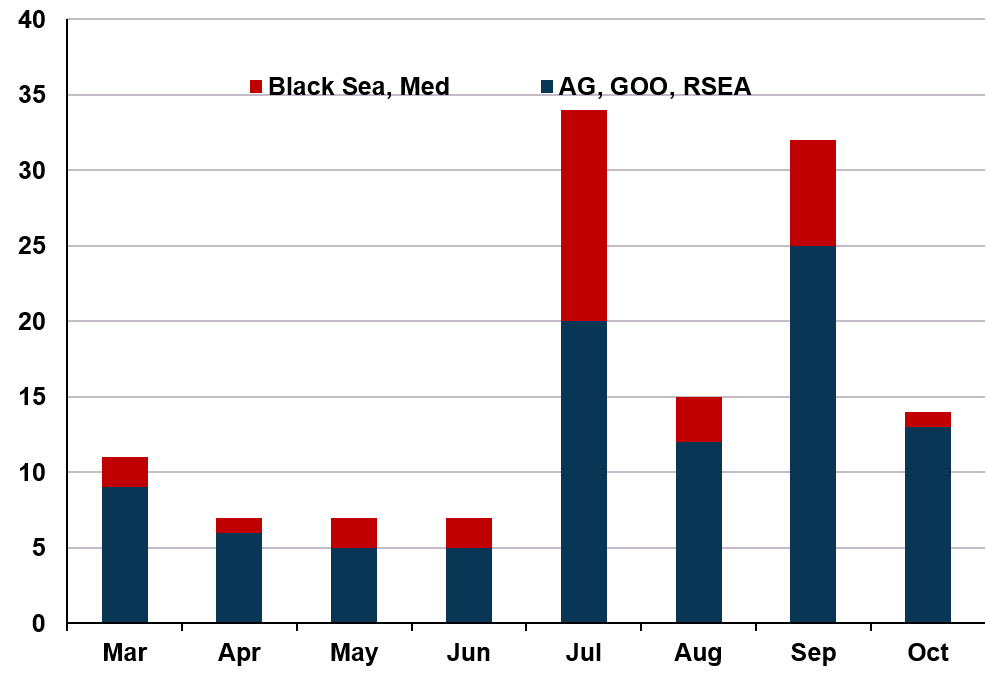
Last week, tanker attacks in the Middle East hit their highest levels since the war began and that pace has continued this week. Further, in the past 48 hours, attacks have broadened to the Gulf of Oman and Arabian Gulf, expanding beyond the Hormuz chokepoint. Since the war started, Gibson has tracked 95 attacks on tankers in the region, including Iranian trading tonnage. The actual number is likely higher due to suppressed reporting. Damage has ranged from superficial to severe, with some vessels requiring extensive repairs or being lost entirely. We count 9 VLCCs being struck in the last 12 days alone.
The increase in attacks coincided with the breakdown of talks following the UN General Assembly in late September, suggesting that Iran is once again escalating attacks in the absence of any progress towards a diplomatic resolution. Surprisingly, the US is yet to publicly retaliate, as it did during early September when several tankers were sunk or disabled, though this could change after the midterm elections in early November. Remember “a tanker for a tanker”?
With the rate of attacks high, vessel supply could tighten further as more vessels are removed from service pending repairs. Insurance premiums and freight rates are also likely to rise as owners reassess risk. The reported attack on a VLCC in the Gulf of Oman further adds to the uncertainty, given that is where the majority of Middle East crude is transhipped onto vessels unwilling to risk a Hormuz transit.
Tracking the impact on vessel supply is challenging. Not all attacks are reported, and the common practice of having AIS turned off in the region makes it difficult to track the period following attacks. Many vessels remained dark following the incidents, making it hard to determine whether trading operations were impacted for a prolonged period, particularly for vessels controlled by national oil companies. However, evidence also suggests many vessels were patched up and quickly returned to service. Around a third of the vessels attacked had sufficient data to track downtime. On average, these vessels waited two months following the attack before loading their next cargo, though some required more extensive repairs in dry dock.
The Middle East has not been the only region where tankers have been targeted. In the Black Sea, frequent attacks were seen over the summer against Suezmaxes and Aframaxes loading at the CPC terminal and other Russian ports. Whilst the extent of the damage varied, on average vessels waited nearly two months before loading their next cargo, spending an average of 25 days at repair yards. Although attacks against vessels loading at CPC have subsided following a US-Ukrainian agreement, vessels trading Russian crude face considerable risks, with a Russian trading Aframax likely destroyed earlier this week.
So long as tensions persist, tankers will remain vulnerable. Growing risks in the Middle East threaten to keep freight rates sky-high, while the delivered cost of oil will also remain inflated from higher insurance costs and logistical challenges. Rising attacks also threaten tanker supply. Even in cases where damage is limited, the temporary downtime whilst condition assessments are conducted further adds operational inefficiencies.
Tanker attacks – Middle East and Black Sea (No.)
Crude Oil
East
The AG/Red Sea VLCC market started the week on a firm footing, with a steady flow of enquiry and several fixtures reported above last done. As the week progressed, activity continued both on the surface and under the radar, gradually tightening the tonnage list and pushing freight to new highs. Owners remained firmly in the driving seat throughout the week, with limited availability allowing them to maintain upward pressure on rates. The market ends the week on a strong note, with little sign of momentum slowing.
Fujairah enquiry eased on Suezmaxes, although further westbound ballasting towards WAF kept availability thin as Atlantic returns strengthened. The market remained heavily influenced by geopolitical developments, with limited tonnage cushioning the impact of slower local demand.
Asia Aframaxes saw another sharp surge this week, supported by tight tonnage availability and exceptional earnings across adjacent markets, including the Pacific, where TMX returns are now well above the $300,000/day mark. TD14 printed WS787, gaining WS238 points since the start of the week, as owners continued to capitalise on a tight list. Regional cargoes were quickly covered, with some turning to smaller sizes for alternative coverage. Requirements ex-NWOz provided further support, with offers reportedly ranging from the low to high WS900s. Looking ahead, owners anticipate another wave of demand, while adverse weather and port congestion could further support rates through potential replacement business. The next round of fixtures will be key in determining how much further the market can stretch. We end the week firm, assessing Indo/Up at 80kt × WS850.
West Africa
The WAF VLCC market remained firm throughout the week, despite limited visible enquiry at times. Strength in the Suezmax market and recent fixtures across the Atlantic continued to support sentiment, while the tonnage list gradually tightened. As the week progressed, further activity confirmed the upward trend and pushed freight to higher levels. Owners remain in a strong position, although fresh enquiry will be needed to determine how much further rates can rise.
Limited VLCC availability for natural end-month dates continued to support split-stem demand as Suezmax rates surged. Outstanding cargoes and sustained Brazilian enquiry further tightened the Atlantic tonnage balance, drawing ships away from WAF and reinforcing owners’ bullish sentiment.
Mediterranean
CPC enquiry slowed as the October programme concluded, although strength in WAF and Brazil maintained elevated owner expectations and limited tonnage replenishment. Black Sea risk remained heightened, with AWRP applicable throughout the whole region. The week closed with levels above WS 1000 reported on subjects.
In the Med Afra market, firm rates continued from last week, with there still being steam left in the market. Owners continued to push ideas higher, with rates of WS 750-775 being achieved – this was largely linked to strength in the wider markets, particularly from the USG, where vessels were seen ballasting over to capitalise on stronger earnings. Port delays helped tighten the list, leading to some forward fixing and further support for the market, with a peak of WS 800 seen. Towards the back end of the week, a slowdown in fresh enquiry suggested the market may be starting to run level out, with a softer undertone beginning to creep in and rates settling around WS 780-785 levels from Ceyhan.
US Gulf/Latin America
The States VLCC market started the week relatively quietly before a surge in activity pushed freight sharply higher. Several fixtures, particularly further south, established fresh benchmarks and strengthened owners’ position across the Atlantic. Despite some high-level deals reportedly failing in the USG, sentiment remained firm, with limited tonnage availability supporting the upward trend. The market ends the week at exceptionally high levels, with owners firmly in control and further enquiry likely to keep pressure on charterers.
North Sea
A decent uptick for North Sea Afras as ballasters, surrounding action and sentiment has pushed up. Local tonnage has been limited with owners’ focus on the US. Rates are still at highs, but things have levelled out a bit. We expect a little bit more of a restrained approach next week, with owners perhaps being unwilling to hold back. Returns are still strong with ideas around WS 620 for local today.
Crude Tanker Spot Rates (WS)
Clean Products
East
Another wild ride for LR rates as we hit never before seen highs again and again. LR2s have been incredibly tight and, with crude markets in the US dragging any western vessels in, the pressure continues to build. Rates this week have been based around the West runs, with 90,000mt jet Sikka/UKC via BEM heading towards $16m. 90,000mt ULSD Yanbu/UKC is now on subs above $12m and likely to go higher. TC1 has been quieter but, given where West rates have reached, 75,000mt naphtha Dohar-Duqm/Japan is at least WS550 and likely nearer WS600. For reference, owners are now asking up to $400k demurrage.
LR1s have been a little quieter, but some East runs have been done. 55,000mt naphtha Sikka/Japan has been done twice at WS550 and, however much owners are pushing for nearer WS600, it has been out of reach so far. West numbers are hard to rate, with owners pushing for over $10m Sikka/UKC but charterers not jumping. With MRs nearer $5m, these LR1 ideas are just a little out of step with other sizes. But as the Strait of Hormuz sees no end so far to the attacks, and crude around the world is still pushing rates, we see no change in direction for the LRs in the AG for now, especially when added to news that China will push exports again.
A quieter week in the AG saw fresh MR cargo enquiry remain limited, allowing lists to replenish and putting some downward pressure on rates. A slow start to the week and a lack of outstanding cargoes saw sentiment flatten, with TC12 tested at WS460 ex Mumbai mid-week before WS465 was reported on subs ex Duqm. TC17 continued to ease, with WS605 repeated as the week drew to a close. Despite the softer tone, prompt availability remains relatively tight and owners are expected to resist any significant further correction. Meanwhile, LR markets continue to push on, offering some encouragement to MR owners, who remain hopeful of a trickle-down effect filtering through next week. With the market showing signs of levelling out, attention now turns to fresh enquiry and whether renewed activity can help support current levels.
UK Continent
The bullish mood amongst MR owners is still palpable, but with paper trading in the mid-300s for November and the physical TA currently at WS200, something is going to have to give here. Laden inbound tonnage has slowed somewhat, so the list is generally going to be tighter going forward, as laden remains the only resupply. The market is geared up for a rally of sorts; there are just not the cargoes to support that quite yet.
The week started with Handy owners well aware of the threat posed by the MRs continuing to compete for and fix natural 30kt clips, so they had to sharpen their fixing ideas or be priced out by the larger ships. 30 × WS340 was the new benchmark for TC23, and UKC/Med also corrected down to the 30 × WS340-345 mark. Enquiry fizzled out in the second part of the week, so eyes are on what units firm up over the weekend and how the tonnage list is looking come Monday. Cargoes are needed here.
Med
MR owners remain relatively bullish here, with an active week holding rates steady throughout. Naphtha flows eastward have been the talk of the town, taking a large bulk of tonnage out of the market for a prolonged period of time. Moreover, LR2 tightness in the Red Sea/AG/WCI region has seen some stems split onto MRs and, as long as LR rates maintain, we expect further erosion of charterers’ options in the Med. WAF runs require a fresh test, but the region still offers willing owners attractive round-trip economics on the basis of a backhaul of middle distillates ex WAF feeding NWE. Med-UKC offers owners a good relocation option in lieu of the supposed ULSD barrel release, whilst XMed rates are stable for owners looking to kill time.
A slow start to the week foreshadowed how we would go on, with Med Handies cagey for the most part. A bulk of business went under the radar, with rates correcting down to the WS345 mark and sentiment stalling; however, enough enquiry trickled through for rates to find a floor. That said WS365 went on subs today on a grade sensitive stem, which requires a long ballast, showing some signs of a rebound. Eyes are on the bad weather forecast for next week, which could strain itineraries and complicate matters, as well as a bullish, tight MR segment, which could give owners a platform to challenge rates from.
Clean Tanker Spot Rates (WS)
Dirty Products
Handy
A handful of naturally placed options remained available in the UKC, though sentiment suggested owners would hold bullish ideas, with initial expectations around WS315-320. The top of the list tightened as vessels were clipped away, while rising MR rates gave owners further confidence. Strength was expected to trickle down into the Handy sector, pushing ideas towards WS320-330. By week’s end, owners were targeting the WS350 mark, with naturally placed tonnage remaining thin.
In the Med, activity got off to a fast start, with vessels steadily clipped away and rates pushed higher, supported by the firmer tone across the wider market. Initial ideas were around WS325-330. Fresh enquiry continued to flow, particularly in the WMed and CMed, allowing rates to firm further towards WS355-360. WS460 was reported out of Taranto; however, given recent restrictions on that trade, we do not view this as representative of the broader market. Owners are expected to hold firm ideas around WS360-365 for the vanilla market.
MR
Limited tonnage in the UKC left owners well placed to firm ideas quickly once enquiry got off to a fast start, with initial expectations around WS245-250. Owners then matched the stronger levels achieved in the Med, with the market moving towards WS300-310. Expectations continued to improve as 80kt stems were split into MR cargoes, quickly thinning the list. A number of fixtures failed, though sentiment remained strong throughout, with availability limited and further tonnage clipped away for Handy stems.
In the UKC the week started with WS300 reported for forward mid-month dates, a significant step up that quickly became the benchmark for owners across both the Med and UKC. Charterers exploring split Aframax stems helped thin MR availability, allowing owners to push ideas towards WS310-320. With Aframax rates still making split stems economical, MR strength is expected to persist, leaving owners well placed to push for further gains.
Panamax
In the UKC, with neighbouring Aframax and MR markets firming strongly, Panamax rates were there to be tested. Owners shared the firmer sentiment and targeted levels above the WS220-230 seen in previous weeks. Higher levels did materialise, with WS325 widely reported, more in line with neighbouring sectors. Despite this, strong TD21 earnings continued to attract tonnage, with Panamaxes still ballasting back to capitalise on the better returns there. For now, rates are expected to remain supported around WS325-350. In the Caribs, rates showed little sign of running out of steam, with strength across surrounding markets allowing Panamaxes to push into the WS615-625 range. The market remained firmly owner-led throughout the week, with steady enquiry and rates continuing to climb. Geopolitical tensions added further support, with owners’ ideas advancing towards WS705-710 by week’s end.
Dirty Product Tanker Spot Rates (WS)
Rates & Bunkers
Clean and Dirty Tanker Spot Market Developments – Spot WS and $/day TCE (a)
| wk on wk change | Oct 8th | Oct 1st | Last Month* | FFA Q4 | |
| TD3C VLCC AG-China WS | 174 | 1,319 | 1,145 | 821 | 1,258 |
| TD3C VLCC AG-China TCE $/day | 201,500 | 1,478,500 | 1,277,000 | 903,500 | 1,397,750 |
| TD20 Suezmax WAF-UKC WS | 253 | 981 | 728 | 327 | 775 |
| TD20 Suezmax WAF-UKC TCE $/day | 161,000 | 590,250 | 429,250 | 171,500 | 450,000 |
| TD25 Aframax USG-UKC WS | 226 | 956 | 729 | 374 | 831 |
| TD25 Aframax USG-UKC TCE $/day | 84,750 | 325,000 | 240,250 | 105,250 | 270,750 |
| TC1 LR2 AG-Japan WS | 1 | 928 | 928 | 786 | |
| TC1 LR2 AG-Japan TCE $/day | 250 | 282,000 | 281,750 | 235,250 | |
| TC18 MR USG-Brazil WS | -114 | 354 | 467 | 261 | 321 |
| TC18 MR USG-Brazil TCE $/day | -21,000 | 44,750 | 65,750 | 27,750 | 35,500 |
| TC5 LR1 AG-Japan WS | -11 | 941 | 951 | 820 | 1,104 |
| TC5 LR1 AG-Japan TCE $/day | -2,500 | 206,000 | 208,500 | 177,250 | 242,250 |
| TC7 MR Singapore-EC Aus WS | 35 | 570 | 536 | 408 | 366 |
| TC7 MR Singapore-EC Aus TCE $/day | -12,000 | 76,250 | 88,250 | 49,250 | 39,500 |
(a) based on round voyage economics at ‘market’ speed, eco, non-scrubber basis
Bunker Prices ($/tonne)
| wk on wk change | Oct 8th | Oct 1st | Last Month* | |
| Rotterdam VLSFO | +34 | 699 | 666 | 690 |
| Fujairah VLSFO | +3 | 955 | 952 | 857 |
| Singapore VLSFO | +56 | 881 | 824 | 842 |
| Rotterdam LSMGO | -33 | 1328 | 1,361 | 1,379 |