Contents
Mid Term Fallout
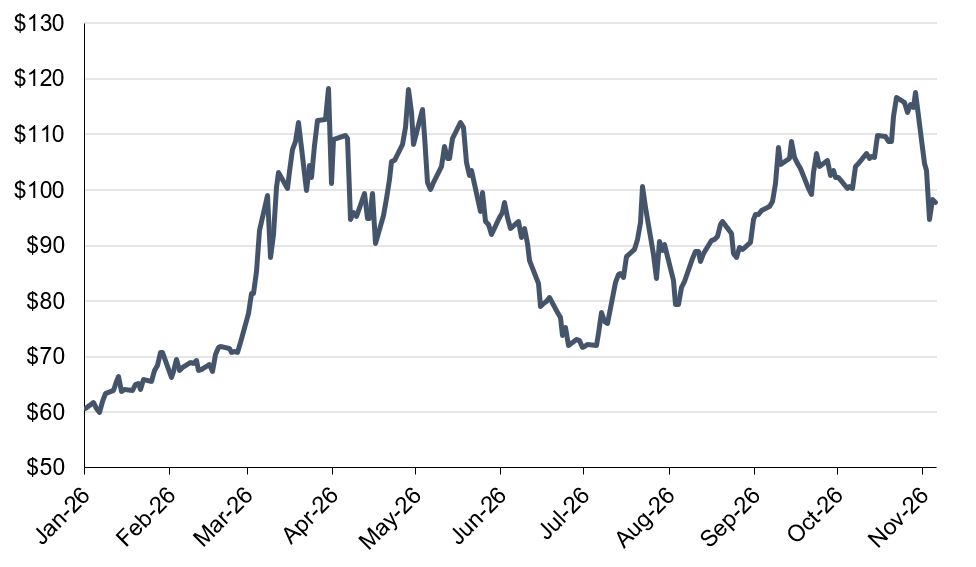
Following weeks of uncertainty, the Democrats have won both the House and the Senate in Tuesday’s midterms. In the Senate, six Republican seats flipped: Texas, South Carolina, Kansas, Ohio, Iowa and North Carolina, with the new Congress sitting from 3rd January. With this new political reality in Washington, attention now turns to how it will affect the Trump administration, given its significant influence on both the oil and tanker markets this year. In particular how it could shape the next phase of the Middle East conflict. The market reacted strongly with Brent falling to $95/bbl and the tanker FFA market pricing down by 27% for December.
For tanker owners, the question is less who sits on Capitol Hill than whether the result shifts the calculus over the Strait of Hormuz (SOH) and the earnings environment it has created.
In the immediate aftermath, the tone from the White House has softened. President Trump told the Financial Times there were “no immediate plans” to strike Iran, adding that “we seem to be getting everything we want”. Tehran’s chief negotiator, Mohammad Bagher Ghalibaf, claimed the vote as an American rejection of war. Importantly, the period before the new Congress convenes in January could open the door either to further escalation or to a peace deal that the White House can claim as its own, rather than being forced to concede under congressional pressure.
With shuttle services supporting a gradual recovery in SOH flows, pressure on the oil market has partially eased, while the tanker market has started to show some signs of softening from the record highs of recent weeks.
On the macro and financial side, US equity futures have seen volatile trading. Amundi described the vote as “more a referendum on AI than on Trump”. The dollar has weakened and US Treasuries have rallied. Uncertainty remains over longer-term US debt levels, but there is a growing view that the new Congress will seek to keep government spending and debt under tighter control. For now, major changes to tariff and non-tariff measures, such as Section 301 and the administration’s maritime measures, look unlikely, as these powers sit with the White House rather than Congress.
The recent US-Russia rapprochement, including the diesel deal, is likely to come under further scrutiny, although it is unlikely to be reversed in the short term. Although, the likelihood of Russian diesel being delivered to US terminals has decreased. What it does raise is the likelihood of tighter sanctions on Russia and greater scrutiny of recent diplomatic and commercial deals, especially once Democrats take key positions on the relevant committees.
On domestic energy policy and US “energy dominance”, Standard Chartered argues a Democratic sweep would not reverse the administration’s oil and gas agenda or quickly alter production levels. Instead, it expects more policy uncertainty and a harder path for energy legislation, which is likely to weigh more on the development and permitting of LNG export infrastructure than on US crude or product exports. That said, greater environmental and regulatory scrutiny of the US upstream sector cannot be ruled out going forward.
From January, the dynamics of the Iran war are likely to change. Trump can still veto any resolution to end the war, as Republicans retain more than a third of the seats in both chambers. But his decisions will face far greater scrutiny and oversight from Democrat-chaired committees, and how the war is funded becomes far less certain. Democrats will be able to block new war funding, as well as the administration’s record $1.5 trillion defence budget request. This points to a narrower window for escalation and more pressure for a negotiated settlement.
So where does this leave the tanker market? For now, little has changed: Hormuz transits remain a key uncertainty, the blockade of Iranian ports remains in force, and diesel stocks remain tight. The real test comes in the weeks before the new Congress is sworn in. A renewed US campaign would extend the disruption and the risk premium that comes with it. A negotiated reopening would return Gulf barrels to the market and unwind the trades built around their absence. For Russia, the diesel deal survives on paper for now, but investigations loom and support for Ukraine could increase. US energy policy is broadly unchanged. What happens next lies in the hands of both Washington and Tehran.
Brent Crude Prices ($/bbl)
Crude Oil
East
The AG/Red Sea VLCC market began the week on a firm footing, although uncertainty surrounding the midterm elections led to a more cautious approach from market participants and the potential for slower enquiry levels. As the week progressed, enquiry gradually eased, and several Gulf of Oman and east-bound fixtures were concluded below previous benchmarks, signalling a loss of momentum. This resulted in a softer market tone, with owners showing increased willingness to secure employment and charterers gaining greater leverage. This was also helped as levels in the Atlantic basin started to look shaky, especially with Suezmax rates taking a hit. While enquiries for VLCCs in Fujairah continued, the pace of activity slowed, and declining freight levels will hopefully encourage more charterers to test the market once we return next week.
The AG Suezmax market remained relatively subdued this week, with limited fresh enquiry and an increasing number of ballasters adding to available tonnage. Geopolitical uncertainty continues to weigh on sentiment and owners’ positioning, although underlying fundamentals remain largely driven by regional supply and demand. With limited immediate support from surrounding markets, sentiment remains cautious.
Asia Aframax activity saw intermittent bursts of regional enquiry this week, helping to trim the tonnage list, though not enough to stop the downward pressure on rates, with earnings slipping to around $175,000/day. A weaker LR2 market could further weigh on Aframax rates ex-NWOZ, with condy stems likely to be covered by the LR2 segment. Across the Pacific, charterers continue to establish new floors as TMX earnings undergo a correction, despite remaining the highest-earning sector. With demand still lacking to absorb available tonnage, sentiment remains soft, and the near term continues to favour charterers. We close the week soft, assessing Indo/Up at 80kt × WS590.
West Africa
The WAF VLCC market continued on the same path as seen in the previous week, with nothing fresh to report. Although rates were still high, a fresh test was needed early on to get a real gauge on sentiment. As the week progressed, sentiment gradually softened as charterers increasingly favoured Suezmax tonnage, taking advantage of more competitive rates and reducing demand for VLCCs. Activity remained subdued throughout the week, and further pressure mounted on the VLCCs, which also wasn’t helped by weakness in the adjacent markets that further weighed on sentiment. Overall, the week ended on a softer note, and a fresh fixture was also reported, which has set the sentiment for next week.
The WAF Suezmax market corrected sharply this week as limited Atlantic Basin enquiry, a weakening VLCC sector and continued softness in paper combined to undermine owners’ resistance. The US midterm elections provided a further distraction for market participants, with charterers remaining largely on the sidelines. Meanwhile, the tonnage list has lengthened considerably, leaving rates exposed to further downward pressure.
Mediterranean
CPC Suezmax rates came under significant pressure this week as charterers adopted a more patient approach amid weakening sentiment across the wider basin. Subsequent fixture failures returned further tonnage to an already growing position list, eroding owners’ leverage and accelerating the downward correction. With fresh enquiry limited, further softening remains likely.
The week started with Aframax rates in the Med being eroded at a rapid pace. Charterers saw WS637.5 done for Ceyhan and were then in no rush to cover cargoes, leaving sentiment to slip further. Throughout the week, the pace of the decline continued, with ample tonnage allowing charterers to take advantage of the lower levels. Despite some signs of bottoming out starting to creep in, another correction followed, with rates falling sharply to WS305 for a decent flat rate. For now, this is where levels remain, as Friday has brought more cargoes to the table and owners are able to be a little more circumspect
US Gulf/Latin America
The USG/Americas VLCC market started the week on a relatively firm footing, supported by previous activity out of Brazil and a limited number of available vessels in the Atlantic basin, which helped maintain freight levels despite attention being diverted by the US midterm elections. As the week progressed, however, fresh enquiry remained scarce, and the market struggled to find direction. While expectations persisted that more VLCC demand would emerge from South America, falling Suezmax rates continued to provide charterers with a more economical alternative, limiting interest in larger tonnage. Weaker sentiment across the Atlantic basin gradually weighed on freight levels, with recent indications suggesting that the market had yet to establish a clear floor. The week ended quietly, with both USG and Brazil requiring a fresh market test to determine viable trading levels, while declining Suezmax rates continued to leave VLCCs at a competitive disadvantage.
North Sea
A pretty uninspiring week, with a lack of action and a lack of inspiration. Rates in the West took a massive tumble this week after what was a very busy period came to a rather abrupt end. We saw minimal weather delays, and the initial draw of the Mediterranean market ran out of steam relatively quickly, with few cargoes being able to entice tonnage from the North Sea. The US market is still yet to take off fully, and that is what’s needed to try and thin out local players and balance the Atlantic basin somewhat more. For now, we see the market slow.
Crude Tanker Spot Rates (WS)
Clean Products
East
A softening was seen across both LR sizes as rates are retested and both segments attempt to find their footing and stabilise. We assess TC1 at 75 × WS400 and TC5 at 55 × WS450 levels come close of play this week. However, with both tonnage lists holding good safe tonnage and a lack of stems heading into the weekend, charterers will be hunting come Monday. It is worth noting that with Bahri week commencing over the weekend, as has been seen in the past, off-market deals can very easily cause a little excitement for the market…
On the AG MRs, consistent enquiry levels up to mid-November dates have combined with a tight tonnage list this week to finally see the Fuj-WCI market go from strength to strength. The week opened with a tight list for natural dates, largely due to EAFR/SAFR ballasters heading east over the last 10-14 days, as we saw TC17 push to WS590 midweek, and we close with 35 × WS600 repeated, with dates pushing towards the start of the last decade of November. TC12 is in need of a fresh test off the back of this movement, with WS500+ expected next done. Going into the weekend, there remains a healthy list of cargoes still outstanding, and as such, owners with firm itineraries are fully in the driving seat for Monday’s trading.
UK Continent
For the MRs, It’s hard to draw a line between an electoral vote in the States and freight levels ex the UKC, but then the track of how we got to the current levels has been one built in part on sentiment. That sentiment has now moved into a more bearish note, and thus rates have softened across the board this week. The real fundamental issue for UKC freight is that it is currently based on UMS and naphtha export grades, as whilst we remain short ULSD and jet, this dynamic remains and the UKC will likely be long on tonnage. Some vessels are choosing to ballast to the USG, but that is a little more costly and risky at this time of year due to the weather.
A week which has seen owners on the back foot throughout, with limited flow and an inactive MR market being the catalysts for further rate drops. A good chunk was taken out of last done levels on Tuesday, with 30 × WS445 paid for XUKC, which was then repeated again. However, MRs remained a threat, and by Thursday 37 × WS325 went on subs for ARA/Med, which is significantly cheaper than what handy owners were talking/offering. Once again, handy owners will have to sharpen their fixing ideas to pro-rated MR levels, otherwise they will continue to lose out on business here. Pressured.
Med
General MR sentiment seems to have passed its peak, and whilst differentials are still blown wide open, the core base rate could ease off. Little fixing activity and inbound laden tonnage from NWE should bolster charterers’ options come Monday and throughout next week, so the emphasis is on how dynamic rates will be. It remains a position, grade, and options game for now, as owners look for exit options. For most, TA remains desired, with States resilience ebbing and flowing above where the NWE/Med markets sit currently. NWE offers a good relocation to an active load zone despite rates slipping in the North, whilst WAF continues to offer good round-trip econs. XMed has inevitably taken a hit as rates reached parity with their handy counterparts, subsequently causing 30kt rates to move southward, thus it is thought MRs will follow suit to stay competitive.
Despite still being inflated, rates have slid throughout this bearish week. Minimal enquiry, staggered fixing activity and MR pressure have been the root causes. It did not seem that enquiry and fixing levels could match those of last week, hence why sentiment began to flip. The question to ask going forward is how much volume needs moving next week. With little seen off the natural window so far, eyes are on how charterers play their cards come Monday. It is thought that a fresh round of enquiry would help owners solidify a new floor. Regardless, charterers will maintain a foothold in this market going into the weekend.
Clean Tanker Spot Rates (WS)
Dirty Products
Handy
In the UKC, the week started with tight tonnage availability, leaving scope for rates to move quickly should a few cargoes come into play, with ideas firm around WS475-480. As the week progressed, limited activity meant rates were not pushed higher, although naturally placed tonnage remained available throughout. Towards the end of the week, the lack of activity saw sentiment soften slightly, with levels easing to WS470-475. Heading into next week, expectations are for this softer tone to remain, with rates likely to be stem-led until fresh enquiry emerges.
Expectations in the Med at the start of the week were for owners to repeat the recently achieved WS500 levels, though activity would need to remain active for that to materialise. As the week progressed, limited enquiry left a handful of vessels available within the natural fixing window, while some units at the top of the list began to rack up idle days, introducing a softer tone to the market. A market quote provided a useful test, with WS475 reported, albeit with a high MF attached. Nevertheless, as the week drew to a close, reports of WS465 began to circulate, indicating the market had softened. Heading into next week, ample tonnage is expected to remain available, with charterers likely to continue testing rates lower.
MR
In the UKC, the lack of a meaningful test in recent weeks left rate ideas around WS400-410. In the Med, where activity had been more evident, expectations were higher, at around WS450-460. As the week progressed, the Med saw little activity to go off, with a test this week reflecting the limited amount of available tonnage and helping levels remain firm around WS450-460. The UKC, meanwhile, was much quieter, with the absence of a well-publicised test making market direction difficult to judge.
The broader theme throughout the week was the significant correction seen in the Aframax market, which is expected to temper owners’ rate expectations in both the UKC and Med. By week’s end, the UKC remained in need of a meaningful test to determine true levels and market direction. In the Med, more tonnage had started to enter the natural fixing window, while softer wider-market sentiment began to weigh on expectations, with ideas easing towards WS430-440.
Panamax
There were a few vessels entering the fixing window at the start of the week, with some being clipped away early on. While reported rates remain buried, expectations were around WS370. As the week progressed, more vessels entered the fixing window, providing additional supply. However, with the Aframax market correcting sharply, sentiment also began to soften. As the week draws to a close, the market remains in need of a well-publicised test to establish where levels truly stand, though rate expectations have become more toned down.
Rates here in the CBS-USG region started the week around WS720, with the tight tonnage list allowing owners to remain firmly in control. As the week progressed, levels managed to hold despite wider markets showing signs of correction. Even as the week draws to a close, rates have largely held flat around WS715, although some pressure is beginning to creep in from the larger sizes.
Dirty Product Tanker Spot Rates (WS)
Rates & Bunkers
Clean and Dirty Tanker Spot Market Developments – Spot WS and $/day TCE (a)
| wk on wk change | Nov 5th | Oct 29th | Last Month* | FFA Q4 | |
| TD3C VLCC AG-China WS | -42 | 1,221 | 1,263 | 1,319 | 1,065 |
| TD3C VLCC AG-China TCE $/day | -42,750 | 1,366,000 | 1,408,750 | 1,478,500 | 1,177,000 |
| TD20 Suezmax WAF-UKC WS | -284 | 430 | 714 | 981 | 533 |
| TD20 Suezmax WAF-UKC TCE $/day | -179,000 | 238,750 | 417,750 | 590,250 | 297,000 |
| TD25 Aframax USG-UKC WS | -308 | 399 | 707 | 956 | 521 |
| TD25 Aframax USG-UKC TCE $/day | -114,000 | 115,750 | 229,750 | 325,000 | 155,250 |
| TC1 LR2 AG-Japan WS | 2 | 1,005 | 1,003 | 928 | |
| TC1 LR2 AG-Japan TCE $/day | 4,250 | 308,250 | 304,000 | 282,000 | |
| TC18 MR USG-Brazil WS | -86 | 496 | 582 | 354 | 402 |
| TC18 MR USG-Brazil TCE $/day | -14,000 | 70,750 | 84,750 | 44,750 | 51,000 |
| TC5 LR1 AG-Japan WS | 4 | 1,025 | 1,021 | 941 | 864 |
| TC5 LR1 AG-Japan TCE $/day | 4,250 | 227,250 | 223,000 | 206,000 | 184,750 |
| TC7 MR Singapore-EC Aus WS | -37 | 541 | 579 | 570 | 538 |
| TC7 MR Singapore-EC Aus TCE $/day | -3,750 | 71,750 | 75,500 | 76,250 | 70,000 |
(a) based on round voyage economics at ‘market’ speed, eco, non-scrubber basis
Bunker Prices ($/tonne)
| wk on wk change | Nov 5th | Oct 29th | Last Month* | |
| Rotterdam VLSFO | -51 | 717 | 768 | 699 |
| Fujairah VLSFO | -119 | 869 | 988 | 955 |
| Singapore VLSFO | -130 | 855 | 985 | 881 |
| Rotterdam LSMGO | -158 | 1243 | 1,401 | 1,328 |