Contents
Prisoners of Geography
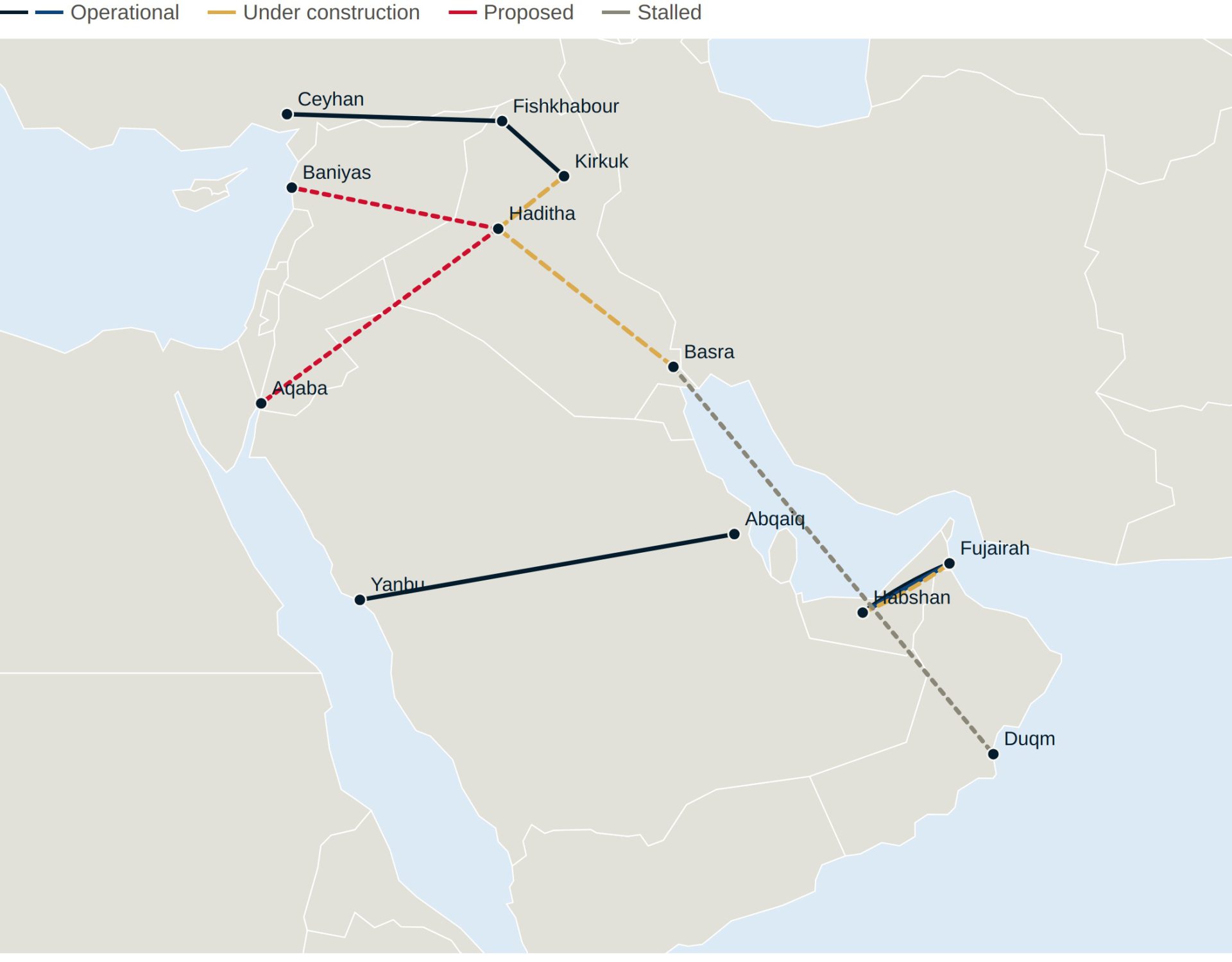
As the War in the Middle East drags on, Middle East exporters continue to adapt operations as best they can, with their specific geography and access to routes bypassing the Strait of Hormuz being the primary success factor. Saudi Arabia, the UAE and Oman, who all have access to domestic ports outside Hormuz, have emerged as the “winners”, but still lack sufficient alternative export routes. Iraq has access to the Mediterranean via Turkey and has been trucking fuel oil via Syria but is vulnerable to regional politics and bilateral relations. As regional producers push ahead with expanding their export options outside of Hormuz, monitoring the development of these projects is critical to determining longer term demand trends for tankers.
Saudi Arabia:
Saudi Arabia is considering expanding its pipeline to the Red Sea by up to 2mbd. Kuwait has said it is in discussions with Riyadh on how to expand the system to accommodate Kuwaiti barrels. It was also reported that refined products were under consideration, yet no timelines were given. However, the main bottleneck is Yanbu loading capacity, with infrastructure improvements at the port needed to realise the full existing 7mbd capacity of the East-West pipeline. Crude loadings at Yanbu averaged 4.65mbd, testing infrastructure to the limit compared to the previous record of 1.7mbd.
United Arab Emirates:
The UAE is pushing ahead with a second pipeline to Fujairah, which will double capacity to 3.6mbd and provide a sufficient hedge to any future Hormuz disruption. The pipeline could be operational later in 2027 once the associated port infrastructure is complete.
Iraq:
Iraq, which has been one of the countries most impacted by the Hormuz closure, has long held access to export routes via Turkey to the Mediterranean. Technically, capacity in this route is 1.6mbd but given damage and corrosion to the federally controlled line, only the KRG section is operational. Exports via Turkey at times reached 600kbd, however flows have barely exceeded 200kbd since it restarted in late 2025. Even with the Hormuz closure, Iraq has been unable to leverage this alternative export route. Therefore, the country is now developing a 2.25mbd pipeline connecting Basrah to the Kirkuk-Ceyhan system at Haditha, intending to expand export capacity significantly, if repairs can be made to restore export capacity to Turkey back to 1.5mbd (even if port capacity is insufficient). A second 1mbd pipeline from Haditha to Aqaba in Jordan has also been proposed whilst a MOU was recently agreed with Syria for an 800km 2.5mbd pipeline from Haditha to Baniyas. The timeline for both projects is unclear. A further project linking Basrah to Duqm in Oman appears to have stalled.
Impact on Tankers:
The key will be which pipelines actually get built and what utilisation levels they run to. Prior to this year, exports from Yanbu rarely exceeded a third of export capacity. The same could be true for Iraqi westbound pipelines which would primarily be used to service European demand. Asian buyers would prefer to load out of the Gulf in “normal” circumstances and given the demand growth is primarily in the East, westbound export routes would likely be underutilised. In the UAE, the impact on tankers would be limited. If exports permanently shift to Fujairah, a small loss in demand would materialise, but this would likely be offset by rising Emirati production. The biggest impact therefore is likely to be on tankers carrying Iraqi volumes to Europe on VLCCs and Suezmaxes, which averaged around 700kbd in 2025. The impact on product tankers is likely to be negligible, with only Saudi Arabia currently considering a products pipeline to the Red Sea.
However, as much as these projects are designed to be an insurance policy for Gulf producers, they would also do the same for tankers, meaning that if the situation in Hormuz were to remain in place for years, or be repeated in the future, the market would be less vulnerable to a loss of cargo than before. Yet, pipelines themselves face security challenges, being hard to defend, particularly in countries where rebel groups and foreign-backed militias also operate, compounded by an era where low-cost drone warfare reduces the sophistication required to disrupt exports.
Hormuz bypass pipelines
Crude Oil
East
The AG and Red Sea VLCC market remained well supported throughout the week, with geopolitical developments continuing to dominate sentiment. Early in the week, strong activity saw several vessels quietly disappear from the tonnage list, tightening prompt availability and lifting freight levels. Fixtures concluded at elevated rates reflected the additional risk premium demanded by owners following attacks on oil tankers. Toward the end of the week, hopes of lower tensions between the US and Iran were briefly raised by small transits through the Strait of Hormuz, though this optimism did not last long, and freight remained firm with owners retaining the upper hand. Attention will now turn to next week’s enquiry levels to determine whether momentum can be sustained.
The Suezmax market in the Middle East continues to see strikes across the AG, with security risks remaining elevated. Cross-AG and Red Sea employment persists, although a growing number of owners are opting to reposition West, steadily increasing tonnage in the Atlantic.
Asia Aframaxes ended the week on a firmer operational footing, with prompt tonnage clearing out as a result of under-the-radar fixing and several owners opting to ballast away from the region. Despite the tighter front end, freight struggled to gain traction, with TD14 remaining unchanged for a fourth consecutive session, suggesting charterers continue to dictate the pace. A fresh low was established on a northbound fixture, setting the benchmark heading into next week. Attention now turns to the next long-haul test, which should provide a clearer indication of whether owners can begin to regain negotiating leverage. Across the Pacific, TMX activity picked up with a series of late second- and early third-decade requirements absorbing positions, though owners were similarly unable to push rates beyond prevailing levels, with fixtures largely repeating last done. We close the week broadly flat, assessing Indo/Up at 80kt × WS150.
West Africa
The WAF VLCC market experienced a relatively quiet week, with enquiry remaining limited despite firmer conditions elsewhere. A steadily tightening tonnage list continued to underpin sentiment, while owners looked for increased activity to maintain the recent gains. By the end of the week freight held broadly steady, although a meaningful pickup in cargo volume will be needed to push rates higher. Should enquiry improve, charterers are expected to attract additional ballasters from the East, which should continue to provide support to the market.
Enquiry in the WAF Suezmax market remained notably thin for much of the week, with downward pressure on rates gradually building. A brief injection of Guyana stems provided some support to the Atlantic, though it proved insufficient to prevent rates from softening. Ongoing geopolitical uncertainty continues to draw eastern ballasters West, leaving the market poised to open on a softer footing next week.
Mediterranean
As the week draws to a close, the Med Aframax market appears to have run out of steam, with levels having suffered a noticeable decline from where proceedings began. Inactivity was the main culprit, as owners’ calls of “is there much going on” really did echo aloud; knowing this, they faced increased competition for stems when opportunities finally presented themselves. Lows of WS315 cross-Med were concluded, and with further testing being performed at time of writing, any stability in the short term is now likely to come from the US, where after suffering a little blip, positive sentiment has resumed once again.
Another volatile week in the CPC Suezmax market. The brief resumption of production saw rates tested around WS430, but renewed attacks and a subsequent suspension of loadings resulted in reported business failing. With tonnage once again building in the Mediterranean, the market returns to a wait-and-see stance pending further developments.
US Gulf/Latin America
The States VLCC market showed encouraging signs during the week, with a series of fixtures helping tighten the prompt tonnage list and reinforce firmer freight levels. Although a number of reported deals ultimately failed, overall sentiment remained positive as activity continued to emerge, particularly from the US Gulf. Rumours of fresh fixtures persisted toward the end of the week, while tonnage availability remained relatively balanced, with some vessels opening in the UK Continent likely to seek Atlantic employment. Owners will now be looking for stronger enquiry next week to maintain the current momentum and further strengthen freight levels.
North Sea
A pretty tepid week for North Sea Aframaxes, with little happening overall in the Cont outside of standard fixing. Rates are sliding closer toward WS200 and those with alternative options are taking them. There have been some hold-ups here and there, but this week really gave us the feel of a summer market again. There will be further rate erosion into the beginning of next week with the build-up of tonnage against limited options. With August around the corner, most of this is unsurprising, and we will simply settle into more of a summer norm.
Crude Tanker Spot Rates (WS)
Clean Products
East
As the Middle East goes from one crisis to another, it is not clear when any normality will return. With the Houthis attacking Red Sea ports as well as three vessels off Saudi Arabia, the main outlet replacing AG supply has seen rapid freight rises alongside a lack of owners willing to even call terminals in the Red Sea. Cross-Red Sea LR1 freight has trebled, and West runs, although not seen so far since the latest attacks, are likely to be over a million up on last. Rates on LR1s ex Sikka and Fujairah/Sohar have stabilised, with TC5 paying WS150 and 60kt jet to UKC around $3.0m. With the SoH still a struggle for most, it remains difficult to rate an AG load, but this is expected to be around the WS550 level. LR2s are in a similar place, although with the list slightly tighter we have seen rates hold on TC1 at closer to parity with TC5. West runs ex Sikka will likely be $4.5m via Cape, but over $5m if Suez routing is needed. An LR2 is reported at $8.0m now for loading Ruwais to UKC, so we will see if that is where it lands. Overall, the reduced traffic through the SoH continues, with the added issues of Bab el-Mandeb and the Saudi port attacks, leaving us as far away from stability as we have been since the latest conflict started.
A busy week for the AG MRs, with the tightening front-end list continuing to support rates. TC17 climbed from WS235 ex-Sikka at the start of the week to WS300 on subs by Friday, with owners continuing to ballast East in search of stronger AG earnings. TC12 and westbound runs are still expected to positively correct following the sharp move higher on TC17. The Red Sea remained active despite ongoing uncertainty surrounding BEM transits, while TC7 softened over the course of the week. With the list remaining tight and fixing windows now extending into mid-August, expect rates to remain firm into next week, with further upside possible should enquiry continue.
UK Continent
With the gasoline arb transatlantic shut all week, we have only seen contract barrels going TA, and thus any enthusiasm for a push on rates has been largely thwarted. The list still remains tight, however, as numerous ships decided to ballast to the USG for better returns, so if we see an uptick in cargoes then of course the bullish rhetoric will return. Rates are still quite volatile as the variety of cargoes and desired destinations are viewed very differently by each owner, on the strategy of where to end up next. The fixing window now stretches to the 10th of August, which is historically quite far forward in what has been a very prompt market.
An active week for Handies plying their trade in the North. Consistent enquiry for both XUKC and UKC/Med, against a tonnage list lacking supply, resulted in TC23 firming to 30 × WS240. A good amount of Med runs have also meant a few ships have left the region, which will make the lists interesting come early next week.
Med
With the Black and Red Seas becoming a no-go for some owners, the Med has remained pretty flat this week, as those with tonnage discharging have had to face the music on cargoes to exit the region. We have also seen some units ballast away, having failed to find cargoes or simply feeling returns were better elsewhere. August is traditionally quite slow for the Med market, so the question over the next few weeks is whether it behaves like previous years.
Momentum has flip-flopped between the two parties rather rapidly this week, as often seen in this turbulent Mediterranean market, and we arrive at Friday still trying to figure out what went wrong for owners. With a thinly spread list on Monday, owners were able to take advantage and press rates quickly, and by mid-week we saw a 70-odd point gain up to the WS250 mark. But this spike did not go unseen by the local MRs, and suddenly a few more options opened up for charterers. This, partnered with a lack of fresh stems, saw 30 × WS225 achieved, as well as rumoured less on some older tonnage. Charterers have managed to wiggle control off owners again, and we expect further decline on vanilla moves should Monday arrive with continued slow fixing.
Clean Tanker Spot Rates (WS)
Dirty Products
Handy
A steadier but consistent flow of cargoes in both regions this week, rather than the somewhat frantic pacing seen in recent weeks. The week began with what felt like a bit of a breather before enquiry started to surface. The North started with a tight list from the off, with few naturally placed units to choose from and WMed positions making up the vast majority. Despite this, rates haven’t firmed in the aggressive manner perhaps expected, with WS305 repeated a couple of times before ideas now sit around WS315-320 by close of play on Friday. Supply is expected to remain tight in the North as we head into next week, which should see owners look to close the gap on the Med if enquiry enters the market quickly.
Down in the Mediterranean, a similar story, with a quiet Monday before enquiry and off-market dealings began to chip away at the list, rates moving steadily through the gears from WS345 to WS355, with ideas now expected around the WS360 mark by week’s close. A handful of ships are expected to be available off early positions at the start of the week, but it won’t take much to move the needle again and for owners to start testing upward. Charterers will be hoping for favourable replenishment levels in order to slow some of the momentum that has gathered in recent weeks.
MR
Another week of little to no full-stem activity, with both sectors in need of fresh tests. In the North, much like the Handies, tonnage is situated WMed, opening the door for owners to push last done levels onward should full-stem enquiry surface. We expect next done levels tested between the WS250-260 range. In the Med, there are fewer recent tests to go off, but generally we feel rates are expected to fall around the WS260-270 mark, load and date depending.
Panamax
An interesting week for Panamax owners in the States and surrounding markets, with enquiry continuing to flow into an already tight list as levels tested upward into the WS370s by the end of the week, despite the larger sizes seeing a bit of a slowdown. Sentiment here remains firm, and we expect the upward trend to continue as we head into next week. Over in the UKC and Med, firm enquiry has been scarce, with questions here and there but little yet by way of solid enquiry. Rate ideas hold around the WS190-200 mark, but this needs to be freshly tested. As TD21 firms, owners are looking at locking in healthy returns and ballasting back to USG/Caribs rather than hanging around for backhaul stems unless cargoes are off dates.
Dirty Product Tanker Spot Rates (WS)
Rates & Bunkers
Clean and Dirty Tanker Spot Market Developments – Spot WS and $/day TCE (a)
| wk on wk change | Jul 31st | Jul 24th | Last Month* | FFA Q3 | |
| TD3C VLCC AG-China WS | 38 | 424 | 387 | 294 | 375 |
| TD3C VLCC AG-China TCE $/day | 45,000 | 446,250 | 401,250 | 303,250 | 378,750 |
| TD20 Suezmax WAF-UKC WS | -6 | 222 | 228 | 243 | 223 |
| TD20 Suezmax WAF-UKC TCE $/day | -3,000 | 107,500 | 110,500 | 126,000 | 99,500 |
| TD25 Aframax USG-UKC WS | -68 | 375 | 443 | 171 | 293 |
| TD25 Aframax USG-UKC TCE $/day | -24,750 | 108,000 | 132,750 | 36,000 | 69,750 |
| TC1 LR2 AG-Japan WS | -2 | 497 | 499 | 362 | |
| TC1 LR2 AG-Japan TCE $/day | 0 | 140,250 | 140,250 | 99,750 | |
| TC18 MR USG-Brazil WS | 42 | 346 | 304 | 322 | 270 |
| TC18 MR USG-Brazil TCE $/day | 8,750 | 44,500 | 35,750 | 43,250 | 27,250 |
| TC5 LR1 AG-Japan WS | -6 | 519 | 524 | 356 | 366 |
| TC5 LR1 AG-Japan TCE $/day | -500 | 104,750 | 105,250 | 68,750 | 63,250 |
| TC7 MR Singapore-EC Aus WS | -9 | 269 | 277 | 299 | 232 |
| TC7 MR Singapore-EC Aus TCE $/day | -750 | 26,500 | 27,250 | 34,750 | 19,000 |
(a) based on round voyage economics at ‘market’ speed, eco, non-scrubber basis
Bunker Prices ($/tonne)
| wk on wk change | Jul 31st | Jul 24th | Last Month* | |
| Rotterdam VLSFO | -7 | 683 | 690 | 565 |
| Fujairah VLSFO | -26 | 810 | 836 | 778 |
| Singapore VLSFO | -18 | 803 | 821 | 642 |
| Rotterdam LSMGO | +67 | 1297 | 1,230 | 909 |